Everyone has something different that they like to do in places they live and visit. For us, the parks and hiking trails are one, and trying new restaurants is another. I thought I would share our favorite restaurants we have discovered in Alaska to date. If anyone has a good one to share, please let us know so we can try it out as we travel!
Cosmic Kitchen in Homer: You know a restaurant is good if it actually has 2 of them in a town the size of Homer! One is in the main part of town, while the other is out on the Spit. The smoothies are the best: they fill up a big cup with real fruit (not the imitation flavoring) and blend it up. Yum! The nachos are great, the burgers are delicious, and the only thing we have found that we don't like are some of their soups (they turn some things into soup that I wouldn't expect to be soup!). Overall, they are a good standby that we can always count on getting a good meal at.
Blackwater Bend between Homer and Anchor Point: I know, they're a coffee shop, not a restaurant, but I can't resist mentioning them. They're in the middle of nowhere (actually, across the road from Norman Lowell's studio & art gallery), but they nearly always have a line of cars at their drive-up window, which signals to me that they must be good! I tried a coffee smoothie there and it was divine! They have gigantic cinnamon rolls, and a nice selection of other on-the-go foods.
Hash Browns in Anchor Point: No restaurant is perfect, but I sure appreciate when they own up to their mistakes. When we went here a few weeks ago the waitress accidentally wrote down the wrong order for the kids. When I pointed it out to her, she didn't question it, she just took it right off the bill. It seems like most of the time if a restaurant makes a mistake you have to fight them to do anything about it, and it is more stress than it is worth. Hash Browns earned my loyalty by not making me fight. The pace of service is small town slow, so it is best to have plenty of time when you go.
The Crossings in Soldotna: This restaurant has the look of class, so I was not sure we would be welcomed when we wandered in one Saturday after a morning of berry picking, stains on our knees and twigs in our hair. When I asked the hostess about our attire, she just said meaningfully, "This is Alaska," so I guess dress is not an issue. This is a classy restaurant. It overlooks the Kenai River, has multiple levels, lots of windows, conservative and trained waitstaff, pleasant music, and good food. It was a gem to discover. We've spent $60 on plenty of meals in Alaska, but usually it was at a hole-in-the-wall with terrible service and bad food. We left The Crossings fully satisfied with our dining experience and happy to pay the restaurant for it. I am looking forward to an excuse to go there again when we're in town!
Alcapalco in Kenai: Again and again, the Alcapalco Mexican Restaurant is mentioned as a good place to eat at in Kenai when we ask people for a good restaurant. It has an extensive menu, and the two times I have been there the service was excellent--really outstanding. The food is good and the prices in line with what you are getting. It's nothing razzy dazzy, just a great place to go out for lunch with a group. Oh, and we really like their salsa. It will now be a regular stop for us when we are in Kenai to take some salsa to go.
There is an awesome Oriental buffet in Anchorage, and a great steakhouse/pub in Skagway, but I can't recall the names...I'll have to track them down.
The most fascinating thing about eating out in Alaska is the lack of chain restaurants. It is refreshing! Back in Gaylord, Michigan, I think the town was down to maybe 5 non-chain restaurants. It was hard to find a place to eat that actually had unique food. In Alaska the pendulum is far off in the other direction (at least in the non-metropolitan areas), with chain restaurants few and far between. I believe McDonald's is the only chain restaurant in Homer, out of something like 30 restaurants (in the summer). So we lose the consistency, but we gain when we find gems of culinary delight in out-of-the-way places. It takes much patience and trial and error to find good places to eat out. These are our favorites to date. Hope you enjoy them if you're in the area!
Saturday, October 18, 2008


Wednesday, October 8, 2008
First snow...and still snowing
 Sunday morning we woke up to a white world. Six inches of snow had collected overnight, transforming our green and brown world to black and white. The local pond (above) had a thin sheen of ice on it, and the ground was almost completely frozen. Just one week ago I cleaned out my garden: dug my veggies and pulled everything up. This was the day I was going to rent a rototiller and till in my compost. Looks like I missed the moment, and it's not going to happen till spring.
So Sunday was a play day, with the kids and I cross country skiing all over the local pastures, exploring the world from a different perspective! Snow forts went up, snowball fights ensued, hot cocoa was consumed and it was a joyous day. I fully expected the snow to all melt, as it was a sunny day, but it only melted a tiny bit, and snow has continued to drift down each day since adding to the base. It occurred to me that snow usually "sticks" till May 15 up here, so if this snow "sticks," that will be over 7 months of snow! Any takers??!! Or you can live in Homer where there's no snow (yet)!!
Sunday, October 5, 2008
Butchering the Local Cows
Friday our neighbors called and said they were butchering their cows, and did we want to come and watch or help? I was actually pretty excited to see the process, so Saturday was set aside to discover what it is like to butcher a cow...to see firsthand how food goes from a living animal to a steak on our plate.
Note: These are not the typical beautiful Alaskan pictures I post on my blog. However, if this blog is about "Life in Alaska", I don't feel quite right editing out the "rougher" or "baser" parts of life up here. People everywhere butcher cows (and goats, pigs, chickens, etc.), but for our family, it is not something we encountered or experienced in our lives up until now, so that makes it part of our "Alaskan" experience. My 10-year-old daughter used 2 words to describe this process: "interesting" and "boring". I agree. I hope you enjoy, or at the very least appreciate, this photojournal of the process.
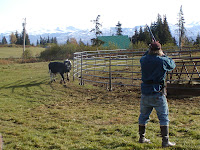
Our neighbors are hunters, so it was a simple thing to choose the gun and bring it down to the cow pasture. Compared to being mauled and eaten by a wild animal, being shot is an easy way to go. The cows didn't know they were about to be killed, and even after a couple had been killed, skinned and gutted, the others just stood around watching. The was no sense of agitation at all. This is part of what surprised me about this process. Even chickens (which I have butchered myself) get more upset than these cows did.
Bleeding an anima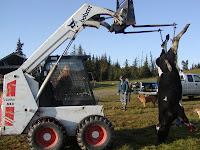 l needs to happen fairly quickly, so the moment the cow is down (one shot between the eyes), someone cuts the artery below the heart. It takes a few minutes for the reflexes to stop so that the cow stops kicking. I've seen this same reflex at work on moose that have been hit by a car. Once the cow has been bled, it is hung. In this case, our neighbors have a Cat with a forklift, which is very convenient. If this were a moose out in the woods the process would be a lot messier. The cow is brought to a good spot and laid on its back, propped up between a couple of logs to keep it steady.
Skinning the cow was th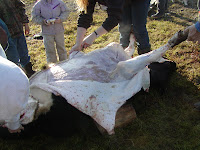 e part I was dreading the most, I think, but I was amazed at how clean it was. The only blood is what might have gotten on the cow when it was bled. Other than that, it seems the blood is contained and so it is not a gory process at all. Really, sterile is the word that comes to mind. The skinning is routine work, and fairly simple. There were 4 of us "newbies" there to observe and help how we could, and we all felt pretty competent by time we were done. After the legs are skinned they are sawed off mid-leg, and after the belly has been sliced open, the sternum is sawed as well.
This entire pro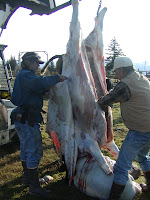 cess, from shot to the end when the cow is quartered and hung took less than an hour. Normally it takes them less time when they don't have inexperienced people helping. They take their cows to a processor so that they get good cuts, sausage, stew meat, etc. made up. Apparently the meat can hang for 10 days in cool weather before it begins to go bad. The heart is the only internal organ that they keep, and they give the tongues to someone who enjoys cooking them up.
For people who have been raised in hunting families or on farms, this is probably all old hat. I was not, so this was a new experience for me. I don't think I would go and start raising myself a cow and butchering it myself, but the whole concept of growing your own food--meat--is not quite so foreign to me anymore.
The carbon footprint for these cows is very low. They are raised on the farm over winter, fed grass, butchered here and driven a few miles down the road to the processor. Part of the problem with typical meat bought in the stores today is that it takes an immense amount of energy to grow, butcher, process and ship to stores all over the country or world. The carbon footprint is large, and much of the nutritional value of the meat is lost due to being corn-fed animals. It is neat to see how it "should" be done, or at least seeing that some people still have the skill, equipment and know-how to actually feed themselves.
Note: These are not the typical beautiful Alaskan pictures I post on my blog. However, if this blog is about "Life in Alaska", I don't feel quite right editing out the "rougher" or "baser" parts of life up here. People everywhere butcher cows (and goats, pigs, chickens, etc.), but for our family, it is not something we encountered or experienced in our lives up until now, so that makes it part of our "Alaskan" experience. My 10-year-old daughter used 2 words to describe this process: "interesting" and "boring". I agree. I hope you enjoy, or at the very least appreciate, this photojournal of the process.

Our neighbors are hunters, so it was a simple thing to choose the gun and bring it down to the cow pasture. Compared to being mauled and eaten by a wild animal, being shot is an easy way to go. The cows didn't know they were about to be killed, and even after a couple had been killed, skinned and gutted, the others just stood around watching. The was no sense of agitation at all. This is part of what surprised me about this process. Even chickens (which I have butchered myself) get more upset than these cows did.
Bleeding an anima
 l needs to happen fairly quickly, so the moment the cow is down (one shot between the eyes), someone cuts the artery below the heart. It takes a few minutes for the reflexes to stop so that the cow stops kicking. I've seen this same reflex at work on moose that have been hit by a car. Once the cow has been bled, it is hung. In this case, our neighbors have a Cat with a forklift, which is very convenient. If this were a moose out in the woods the process would be a lot messier. The cow is brought to a good spot and laid on its back, propped up between a couple of logs to keep it steady.
Skinning the cow was th
 e part I was dreading the most, I think, but I was amazed at how clean it was. The only blood is what might have gotten on the cow when it was bled. Other than that, it seems the blood is contained and so it is not a gory process at all. Really, sterile is the word that comes to mind. The skinning is routine work, and fairly simple. There were 4 of us "newbies" there to observe and help how we could, and we all felt pretty competent by time we were done. After the legs are skinned they are sawed off mid-leg, and after the belly has been sliced open, the sternum is sawed as well.
This entire pro
 cess, from shot to the end when the cow is quartered and hung took less than an hour. Normally it takes them less time when they don't have inexperienced people helping. They take their cows to a processor so that they get good cuts, sausage, stew meat, etc. made up. Apparently the meat can hang for 10 days in cool weather before it begins to go bad. The heart is the only internal organ that they keep, and they give the tongues to someone who enjoys cooking them up.
For people who have been raised in hunting families or on farms, this is probably all old hat. I was not, so this was a new experience for me. I don't think I would go and start raising myself a cow and butchering it myself, but the whole concept of growing your own food--meat--is not quite so foreign to me anymore.
The carbon footprint for these cows is very low. They are raised on the farm over winter, fed grass, butchered here and driven a few miles down the road to the processor. Part of the problem with typical meat bought in the stores today is that it takes an immense amount of energy to grow, butcher, process and ship to stores all over the country or world. The carbon footprint is large, and much of the nutritional value of the meat is lost due to being corn-fed animals. It is neat to see how it "should" be done, or at least seeing that some people still have the skill, equipment and know-how to actually feed themselves.
Monday, September 29, 2008
Reflections on Fall in Homer
Fall has always been my favorite time of year. The cooling days, the nip in the air, the vibrant colors, fields of dry corn stalks, orange pumpkins in the garden and the smell of leaves all mingled to create an emotional imprint that filled me with a sense of well being. Fall in Alaska is quite different, and I am learning to love the new signs of the changing season.
Most people don't look forward to the season of snow, but I am filled with anticipation as I notice the peaks across Kachemak Bay have a fresh dusting of snow on them. As fall goes on the "snow line" will creep lower and lower, till we too will be in the midst of snow. The mountains are now whiter than I have seen them in awhile (actually, I haven't seen them too clearly for several months due to so much rain and cloudy days!). The glacier's blue is starting to get covered up again for a long winter.
The smell of fall has always been one of my favorite scents, but the biggest thing I smell in the air here is cold! I know, that sounds strange. But most places I wander just smell cold, with nothing more to stir up my emotions. Once in awhile, perhaps in a thicket of alders, I will catch a scent of leaves, but it is such a small area, and then I leave and the smell is gone. My daughter misses maple leaves most of all, and it is the only thing she ever talks about missing from Michigan. I totally understand.
The colors of fall in Alaska come in hues of yellow. Aspen and alders are some of the few leafy trees, and it doesn't seem like the alders change color. A few weeks back the fireweed plants were a brilliant magenta, which was glorious, but now they are all dead and brown. In some places the ground cover changes color--blueberry plants turn red, ferns turn yellow. The mountains do change color, though it is a different sort of color change than a Midwestern fall. It is beautiful in an awesome way that my eyes eat up hungrily, but it is on such a huge scale. If I were to climb the mountain and stand among the plants, it wouldn't be as awesome as standing below it looking at the rainbow of colors covering the mountainside.
Fall harvest in Alaska has its differences too. Michigan was a time of canning and freezing. Anything I would can would have to be grown in a greenhouse here, so all of our garden harvest has involved washing and freezing: potatoes, carrots, broccoli, cauliflower and spinach. Gardeners I know say when the ground freezes, it freezes quickly, in days, so unless you want to dig your potatoes and carrots with a pickax, you judge just how long you can leave them in and then get them out fast. A week ago we had our first frost, so last week was the week of frantically pulling stuff out of the garden. When it is time for the things to go, they have to go now! So we dug our potatoes and carrots last Monday, and over this past weekend pulled, dug and prepared the garden for winter. It is almost ready, and I am hoping the ground doesn't freeze quite yet so I can get it tilled up.
For the first time in years I haven't been able to enjoy fall as much as usual. Work finds me on the computer long hours teaching online classes, and the rain has kept us indoors a bit more than usual. The first weekend of sunshine this past weekend was breathtaking, as was the rainbow show on Friday evening. For over an hour various rainbows played around Homer, following storm clouds, while the sun shone on it all, creating colorful views. I had worked enough during the week to actually take a day off, so Sunday we loaded up the 4-wheelers and went off looking for berries here, there and everywhere.
Fall in Alaska means the sun is at a lower angle, making it feel late in the day even during the middle of the day.
Fall means picking berries everywhere we go, and then coming home and getting them in the freezer.
Fall means shorter, colder days, with hats, gloves and winter coats already in use daily.
Fall means many people are out hunting, though we're not one of those people....yet.
Fall is the anticipation of snow (for those of us who love it), or the dreading of it (for those who do not).
Fall means hunkering down and enjoying indoor activities again. It means getting out the cribbage board or board games or dusting off the tv/vcr and watching a movie.
Fall means mentally preparing for the season of darkness, and making a plan to get through it--sane.
Yes, fall is different here. I enjoy it, and am learning to love its nuances.
Most people don't look forward to the season of snow, but I am filled with anticipation as I notice the peaks across Kachemak Bay have a fresh dusting of snow on them. As fall goes on the "snow line" will creep lower and lower, till we too will be in the midst of snow. The mountains are now whiter than I have seen them in awhile (actually, I haven't seen them too clearly for several months due to so much rain and cloudy days!). The glacier's blue is starting to get covered up again for a long winter.
The smell of fall has always been one of my favorite scents, but the biggest thing I smell in the air here is cold! I know, that sounds strange. But most places I wander just smell cold, with nothing more to stir up my emotions. Once in awhile, perhaps in a thicket of alders, I will catch a scent of leaves, but it is such a small area, and then I leave and the smell is gone. My daughter misses maple leaves most of all, and it is the only thing she ever talks about missing from Michigan. I totally understand.
The colors of fall in Alaska come in hues of yellow. Aspen and alders are some of the few leafy trees, and it doesn't seem like the alders change color. A few weeks back the fireweed plants were a brilliant magenta, which was glorious, but now they are all dead and brown. In some places the ground cover changes color--blueberry plants turn red, ferns turn yellow. The mountains do change color, though it is a different sort of color change than a Midwestern fall. It is beautiful in an awesome way that my eyes eat up hungrily, but it is on such a huge scale. If I were to climb the mountain and stand among the plants, it wouldn't be as awesome as standing below it looking at the rainbow of colors covering the mountainside.
Fall harvest in Alaska has its differences too. Michigan was a time of canning and freezing. Anything I would can would have to be grown in a greenhouse here, so all of our garden harvest has involved washing and freezing: potatoes, carrots, broccoli, cauliflower and spinach. Gardeners I know say when the ground freezes, it freezes quickly, in days, so unless you want to dig your potatoes and carrots with a pickax, you judge just how long you can leave them in and then get them out fast. A week ago we had our first frost, so last week was the week of frantically pulling stuff out of the garden. When it is time for the things to go, they have to go now! So we dug our potatoes and carrots last Monday, and over this past weekend pulled, dug and prepared the garden for winter. It is almost ready, and I am hoping the ground doesn't freeze quite yet so I can get it tilled up.
For the first time in years I haven't been able to enjoy fall as much as usual. Work finds me on the computer long hours teaching online classes, and the rain has kept us indoors a bit more than usual. The first weekend of sunshine this past weekend was breathtaking, as was the rainbow show on Friday evening. For over an hour various rainbows played around Homer, following storm clouds, while the sun shone on it all, creating colorful views. I had worked enough during the week to actually take a day off, so Sunday we loaded up the 4-wheelers and went off looking for berries here, there and everywhere.
Fall in Alaska means the sun is at a lower angle, making it feel late in the day even during the middle of the day.
Fall means picking berries everywhere we go, and then coming home and getting them in the freezer.
Fall means shorter, colder days, with hats, gloves and winter coats already in use daily.
Fall means many people are out hunting, though we're not one of those people....yet.
Fall is the anticipation of snow (for those of us who love it), or the dreading of it (for those who do not).
Fall means hunkering down and enjoying indoor activities again. It means getting out the cribbage board or board games or dusting off the tv/vcr and watching a movie.
Fall means mentally preparing for the season of darkness, and making a plan to get through it--sane.
Yes, fall is different here. I enjoy it, and am learning to love its nuances.
Sunday, September 21, 2008
Berries! Berries! Berries!
I have been looking forward to sharing my berry pickings for awhile now, and finally amassed the pictures to go with the names after a weekend of berry picking!
Crowberries have to be one of the most common berries in Alaska. Many people don't like their flavor, but I had a friend from Michigan visit recently and she made us a crowberry pie with 4 c.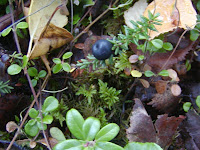 crowberries and 1 c. regular mixed berries from the store (along with the usual amounts of sugar, etc.) and it was delicious! The berries kept their shape so there was a little crunch, which is not something you can usually say about pie. Because many people don't like them, we find them everywhere and pick them everywhere! I throw them in my morning fruit & vegetable smoothie, and my daughter says crowberries are one of her favorite foods. We'll be just fine if nobody else picks them, since then we won't have to drive far for a great, producing patch!
Low bush cranberries were my goal for the weekend. My aunt makes homemade cranberry juice from her cranber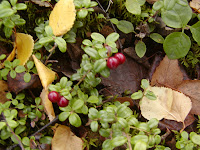 ries, and though the low bush are not as juicy as the high bush, they are still delicious. Of all the berries, these are my favorite, and my mouth is watering just thinking about them. The plants are low to the ground (and grow interspersed with crowberries quite often), but the berries are on the end of the stem and easy to pick. Our family of 4 picked a gallon of them in less than an hour of sporadic picking. The berries are much better after a frost has hit them and the sugars have come up. The berries soften up after a frost too. Last summer I was picking and eating them before a frost, and didn't know what I was missing until I tried some later in the season. I will never go back! Late season camping trips will become the norm so we can get the cranberries after a frost!
Bog blueberrie s are very common as well, growing in all but the very northernmost tip of Alaska. They are a pain to pick; as you can see from this picture, the plants are close to the ground and each stem is loaded with berries. Thus, it is a matter of crawling along on all fours, and picking berries off the ground as they fall as much as picking from the plant. My counsin just introduced me to "berrypickers" today, so next weekend I plan to try this little gadget out to see if it makes picking any easier.
I've only found salmonberries in areas off Prince William Sound or in other temporal rain forest areas.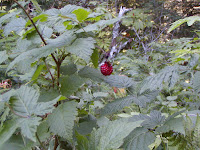 My berry book shows them growing on the entire Kenai Peninsula, but the Seward area is the closest I have found any. These remind me of a cross between a raspberry and and thimbleberry. They are bigger than a raspberry, and not as hairy as a thimbleberry. They grow on big plants and form huge thickets. I would use them to make jam, though we've always found them on hikes, and only picked enough to eat as we walked. They are soft, and so would turn to mush quite quickly.
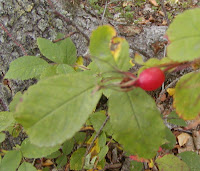
High bush cranb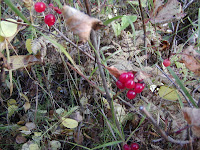 erries were a side treat this weekend that I wasn't expecting to get. They were growing in Kenai near my crowberry patch (notice my possessiveness--"my" crowberry patch!!). The kids were getting tired of picking berries, so quickly filled up a quart, which I will use to make syrup. These are easy to pick, on bushes about 2 feet high, and the leaves had mostly fallen off. The berries are in clusters on the end of a stem, which is one of the distinguishing difference from currants,which are spread out along a stem.
Watermelon berries have always been a treat for the kids (and horses!) when out on the trail. These berries are quite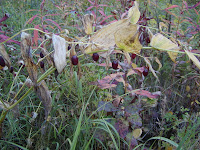 watery, and do have a hint of watermelon flavor to them, thus their name. I mentioned to my aunt that we were going berry picking a few weeks ago, and she gave me a recipe for watermelon berry jam. We tried it, and it was delicious! In the past we've never done more than nibble on these, so it was fun to actually pick them to use. The campground we stayed at in Seward was just filled with watermelon berry plants, though if we hadn't been looking for them, we wouldn't have noticed since they blended in well. Again, few other people seem to pick these to use, so they are plentiful. Plants do not grow in clumps, normally, so you have to pick when you find th
 em and freeze till you have enough.
Rose hips are common in some places, and were mixed in with the high bush cranberries, so we picked and snacked on these. The hairs inside the rose hips are a pain to take out, so we don't use these to make anything. Apparently the hairs irriate the lining of the stomach if eaten. I found them pricking the inside of my mouth.
Nagoonberries (no picture) are actually the berry we have picked the most of this summer (3-4 gallons in our freezer, not counting many eaten raw). A field near where we live is covered with them. The plants are not more than a few inches high, so it is a crawling pick. The berries almost appear to be growing out of the ground at times. When we are done picking these, the kids (and me too sometimes!) have berry stains on our knees or backsides! The flavor and shape of the nagoonberry is similar to raspberries, and my plan for these is to throw them in smoothies. We picked through August, but the past couple weeks they've been over the peak and not good anymore.
There are elderberries everywhere up here, and I have been itching to pick them, but the berries are tiny, and I know they will be a lot of work to pick and clean. They are poisonous when raw, which explains why I've gotten stomachaches after eating them in the past. The seed contains glycoside, which is related to cyanide, which is destroyed when cooking. I would use them to make elderberry jelly, which I recall eating as a kid.
While it is a bummer that few berries ripen in Alaska before mid-August (on the Kenai Peninsula, anyways. In the interior where it is very hot berries ripen sooner), I find it so exciting that there are so many different kinds of berries! Berries can be a significant part of a subsistence lifestyle. It takes little skill to pick berries, they are plentiful, kids can pick them, and they add a tasty, nutritous food to the diet. After we missed berry season last year due to being overwhelmingly busy, I committed to making berry season this year. To my joy, our freezer is filling up!
Crowberries have to be one of the most common berries in Alaska. Many people don't like their flavor, but I had a friend from Michigan visit recently and she made us a crowberry pie with 4 c.
 crowberries and 1 c. regular mixed berries from the store (along with the usual amounts of sugar, etc.) and it was delicious! The berries kept their shape so there was a little crunch, which is not something you can usually say about pie. Because many people don't like them, we find them everywhere and pick them everywhere! I throw them in my morning fruit & vegetable smoothie, and my daughter says crowberries are one of her favorite foods. We'll be just fine if nobody else picks them, since then we won't have to drive far for a great, producing patch!
Low bush cranberries were my goal for the weekend. My aunt makes homemade cranberry juice from her cranber
 ries, and though the low bush are not as juicy as the high bush, they are still delicious. Of all the berries, these are my favorite, and my mouth is watering just thinking about them. The plants are low to the ground (and grow interspersed with crowberries quite often), but the berries are on the end of the stem and easy to pick. Our family of 4 picked a gallon of them in less than an hour of sporadic picking. The berries are much better after a frost has hit them and the sugars have come up. The berries soften up after a frost too. Last summer I was picking and eating them before a frost, and didn't know what I was missing until I tried some later in the season. I will never go back! Late season camping trips will become the norm so we can get the cranberries after a frost!
Bog blueberrie
 s are very common as well, growing in all but the very northernmost tip of Alaska. They are a pain to pick; as you can see from this picture, the plants are close to the ground and each stem is loaded with berries. Thus, it is a matter of crawling along on all fours, and picking berries off the ground as they fall as much as picking from the plant. My counsin just introduced me to "berrypickers" today, so next weekend I plan to try this little gadget out to see if it makes picking any easier.
I've only found salmonberries in areas off Prince William Sound or in other temporal rain forest areas.
 My berry book shows them growing on the entire Kenai Peninsula, but the Seward area is the closest I have found any. These remind me of a cross between a raspberry and and thimbleberry. They are bigger than a raspberry, and not as hairy as a thimbleberry. They grow on big plants and form huge thickets. I would use them to make jam, though we've always found them on hikes, and only picked enough to eat as we walked. They are soft, and so would turn to mush quite quickly.
High bush cranb
 erries were a side treat this weekend that I wasn't expecting to get. They were growing in Kenai near my crowberry patch (notice my possessiveness--"my" crowberry patch!!). The kids were getting tired of picking berries, so quickly filled up a quart, which I will use to make syrup. These are easy to pick, on bushes about 2 feet high, and the leaves had mostly fallen off. The berries are in clusters on the end of a stem, which is one of the distinguishing difference from currants,which are spread out along a stem.
Watermelon berries have always been a treat for the kids (and horses!) when out on the trail. These berries are quite
 watery, and do have a hint of watermelon flavor to them, thus their name. I mentioned to my aunt that we were going berry picking a few weeks ago, and she gave me a recipe for watermelon berry jam. We tried it, and it was delicious! In the past we've never done more than nibble on these, so it was fun to actually pick them to use. The campground we stayed at in Seward was just filled with watermelon berry plants, though if we hadn't been looking for them, we wouldn't have noticed since they blended in well. Again, few other people seem to pick these to use, so they are plentiful. Plants do not grow in clumps, normally, so you have to pick when you find th
 em and freeze till you have enough.
Rose hips are common in some places, and were mixed in with the high bush cranberries, so we picked and snacked on these. The hairs inside the rose hips are a pain to take out, so we don't use these to make anything. Apparently the hairs irriate the lining of the stomach if eaten. I found them pricking the inside of my mouth.
Nagoonberries (no picture) are actually the berry we have picked the most of this summer (3-4 gallons in our freezer, not counting many eaten raw). A field near where we live is covered with them. The plants are not more than a few inches high, so it is a crawling pick. The berries almost appear to be growing out of the ground at times. When we are done picking these, the kids (and me too sometimes!) have berry stains on our knees or backsides! The flavor and shape of the nagoonberry is similar to raspberries, and my plan for these is to throw them in smoothies. We picked through August, but the past couple weeks they've been over the peak and not good anymore.
There are elderberries everywhere up here, and I have been itching to pick them, but the berries are tiny, and I know they will be a lot of work to pick and clean. They are poisonous when raw, which explains why I've gotten stomachaches after eating them in the past. The seed contains glycoside, which is related to cyanide, which is destroyed when cooking. I would use them to make elderberry jelly, which I recall eating as a kid.
While it is a bummer that few berries ripen in Alaska before mid-August (on the Kenai Peninsula, anyways. In the interior where it is very hot berries ripen sooner), I find it so exciting that there are so many different kinds of berries! Berries can be a significant part of a subsistence lifestyle. It takes little skill to pick berries, they are plentiful, kids can pick them, and they add a tasty, nutritous food to the diet. After we missed berry season last year due to being overwhelmingly busy, I committed to making berry season this year. To my joy, our freezer is filling up!
Monday, September 15, 2008
My Kind of Fundraiser!
 Back in March I wrote a blog entry saying that McNeil Canyon School has some of the coolest field trips (Extreme Tubing). Now I get to say they have the best fundraiser I've ever seen: carrots!
 After spending years handling fundraisers where people buy candy, cookies and every form of sugar known to humankind, it is refreshing to have a fundraiser that involves natural sugars right from the ground.
The kids in McNeil's 5th grade class got double duty, doing this fundraiser 2 years in a row since their teacher Bill (pictured in the foreground, left) moved from 4th grade last year to 5th grade this year. Students came prepared in
 muck boots, old clothes and some in wet weather gear. And they all came with the attitude that this is a fun fundraiser: they get to be outside, get muddy, get wet, pick raspberries between trips to the field, stuff themselves on carrots and overall have a blast for the 2 hours it takes them to pull, wash, weigh and bag 500 pounds of carrots.
At $2/lb., the carrots bring in $1000 to help pay for the very cool field trips (they're going to Seward later this week!). Two hours of work (and some planning with pre-orders) makes this pretty simple for the kids. The challenging part is for their teacher to plant, water (not this year!), weed and thin 7 rows of carrots all summer long. My puny 25 foot row of carrots keeps me busy enough. I don't think I'll volunteer to be Bill!
Saturday, September 6, 2008
Seward
 We spent Labor Day weekend in Seward and were blessed with 2 whole days of sunshine. When it started raining on Sunday we decided to head home since we'd visited everyplace we wanted to go. We had 4 highlights of the weekend:
Climbing Mt. Marathon: The view of Resurrection Bay above was taken from the flank of Mt.
 Marathon. This is a 3,022 foot mountain towering directly over the town of Seward. It is best known for the annual 4th of July race up it and back down. I've heard and read so much about it that climbing it (not running it like the racers do) was my main reason for wanting to go to Seward. One of my cousins won the race 2 years in a row. It is a 3 mile round trip race, and the runners wear gloves since there is a cliff in one section. When we went to the visitor's center to find out where it was (There was not a lot of signage), the lady said we could take the "runner's trail" as it is called, but the jeep trail was easier and went up to some falls.
We decided to take the jeep trail after much debate, and we're glad we did since we all ended up being sore the next day going a little over halfway up the mountain to the falls and the bowl that you see pictured here. Guess we haven't been doing enough mountain climbing lately!! It was a pretty trail, not too steep in most places. The pushki was awful, hanging over the trail, but Doug and the kids had pants on so they were fine. It was actually a warm day, which thoroughly surprised us, and so by the time we reached the bowl we were soaked with sweat and happy for the break. We sat and enjoyed the peacefulness for half an hour before heading back down. It took us 1 1/2 hours up, and 1 back down, including stops for berry picking.
 Resurrection Bay Cruise: Another reason we headed to Seward for the weekend was the Boy Scout cruise on Resurrection Bay. The tickets were rock bottom priced (a few hundred dollars off regular prices), though we did have to spend 4 hours on a boat with over 100 kids on it!
The Kenai Fjords Boat Tour was hardly in the same league as the Stan Stevens boat tour we took out of Valdez. Though they go and see the same things (sea life, glaciers, mountains), the boat we were on in Seward was old, wasn't as comfortable, wasn't designed as nicely, and the captain didn't talk
 about the sights much, and the food wasn't as good, so we were a little disappointed. The highlights of the 4 hour tour were getting off at Fox Island for all-you-can-eat salmon buffet (good, but not great), seeing sea lions flopped all over the rocks, and the Dall's porpoises that swam with our boat for at least 10-15 minutes. The other neat thing was when we rounded one of the islands the open ocean swells from the Gulf of Alaska hit the boat. The kids thought that was the neatest, because they've always rode in protected bays or inlets and didn't realize the open ocean was different.
Exit Glacier: Five years ago when we visited Alaska we went to Exit Glacier. It is one of the more accessible glaciers in Alaska, and probably the most visited. It was about a mile hike up to the glacier (and getting further every year!) on a nice gravel trail. The highlight was seeing a black bear crossing the glacier. We stopped at a viewpoint with telescopes and Doug looked through it and was surprised to see a bear! It would disappear and reappear as it went in and out of crevasses. We've seen so many glaciers that we weren't awed by it (plus is was rainy and windy), but it is still amazing to realize how much ice is there, and how long it has been there!
 Ward's Ship's Drydock: I had heard that people from all over Alaska take their ships down to Seward to be worked on. When we were on the cruise we saw a huge white structure across the bay from Seward, and wondered what it was. On our way out of town on Sunday we found the road to get there and drove through the boatyard. It was interesting seeing so many boats dry docked, and this white structure is huge!
That was pretty much our weekend in Seward. We camped at a city campground that had a tennis court at it, which was a treat, though we didn't use it much. We shopped in downtown, and it took us an hour to get through all the shops, which is about how long we last shopping anyways. We checked out the SmokeHouse, a restaurant in a railroad car which a number of people had recommended to us. We had to wait a long time for our food (they have 8 tables, and do one order at a time), and what we ordered was good. And on the way home we stopped along the road and found a highbush blueberry/serviceberry (just like blueberries) patch and managed to pick a gallon in a little over an hour, which was a sweet ending to our weekend!
Subscribe to:
Posts (Atom)