A freak accident today brought me face to face with one aspect of Homer I'd never thought about before: its emergency medical services. Relegated to "A service I won't ever need," I appreciated the speed of response of the EMT's and ambulance. Here's what happened:
We were in the kitchen cooking when I noticed a pan of hot grease smoking. I grabbed it to move to a cool burner and the hot grease splashed my hand. After the most bloodcurdling scream I've ever screamed in my life, I immediately turned on the water and shoved my hand under the stream, told Aurora to call 911 and I proceeded to give the dispatcher the basic info of address, phone number and injury. I chuckled mentally when they asked for directions in addition to the address; the side streets around Homer are a maze and roads look like driveways or houses have no driveways or any other set of weird scenarios.
While waiting for the ambulance (which I thought was overkill but they have to send one) I called Douglas and left a message on his cell phone and then pulled off my wedding band, at which I sent up another scream as the skin sloughed off. I started feeling sweaty and woozy, and it seemed an eternity but was only minutes before Douglas called back and headed home and then a strange car came inching down our icy driveway. It was the first EMT on the scene. Within a minutes two more vehicles pulled up, spitting out EMTs, then my husband peeled in (wondering at the party with so many vehicles) and a minute or two after that the emergency medical truck and the ambulance completed the entourage.
EMTs number two and three assessed the burn and dressed it, we declined transport in the ambulance, filled out paperwork and hopped in the car to head to the hospital.
The emergency room was expecting us, got me right into a room, cut off the bandage, applied a moist saline covering to keep the burn from drying out and then the small town social whirl started.
First one of the nurses walked in and introduced herself as the neighbor across the street (one of the few neighbors we hadn't met), and by time she left we'd signed our kids up to mow her huge lawn come summer.
Then the doctor came in to assess the wound. When he found out Douglas is vice principal at the high school he said, "I need to talk to him." Apparently this doctor pledges money to Homer High School sports teams if the kids stay drug and alcohol free. We had a great conversation while he snipped away my sloughed skin and bandaged up my hand.
I put Douglas to the task of calling our church's prayer chain, his parents and my aunt to get them all praying, to me as essential as dressing the wound.
Before I left they'd made my appointment to see a family doctor tomorrow (yes, on Saturday!) to change my dressing and continue monitoring progress (the severity of a burn is not always immediately evident and I may need therapy to regain full range of motion). An hour in the emergency room ended up being a fast, fun social hour, not something one can normally say about ER visits. It helped that there was virtually no pain, a fact the attending nurse could not believe (she said I should be screaming in agony considering the severity of the burn).
I kept expecting the pain to hit all afternoon, but instead what little pain I had disappeared. I have now had the privilege to see up close what Homer's emergency services are like, and also what it is like to type an entire blog entry with one hand!
P.S. I assure you, you don't want a picture of this, though the hospital did take one!
Friday, March 11, 2011


Tuesday, March 8, 2011
The Iditarod Start!
The start of the Last Great Race on Earth!
Iditarod #39!
Iditarod #39!

We've had things going on every year during the Iditarod start, but this year we committed to going despite basketball regionals going on in Homer. We left Douglas and Aurora to the basketball games and headed up to Anchorage Friday. I opted to stay in the Sheraton in downtown Anchorage since it was only two blocks away from 4th Avenue that the Iditarod racers would be heading down for the ceremonial start on Saturday.
I didn't see
 many signs of the upcoming race until nearly 10:00 p.m. Friday night when I looked out the 14th floor window and noticed dump trucks full of snow rolling in, dumping their loads on 4th Avenue, and taking off. I felt like a kid on Christmas Eve, with the excitement building for the upcoming race. I pondered how the mushers must feel, knowing the big moment had nearly arrived to hit the trail.
Saturday morning when I looked out the window the course was set, a swatch of snow a foot or so deep with extra ridges on the outside to keep the dogs and sleds on track. The intersection a block from the Sheraton
 was covered with snow and monitored by police and snow shovelers, allowing traffic through.
We got down to 4th Avenue at almost 10 am, where the course makes a 90 degree turn onto C Street. Before we knew it, a dogsled and team came sliding by. I thought perhaps it was just a forerunner, but come to find out that was the first racer. Soon a steady stream of racers came by; they were set to start every two minutes. There were 60+ racers, so that was a few hours
 of starts.
We made our way through the ever-thicker crowds closer to the starting line, passing a parking garage lined with fans. We arrived at the starting line but could hardly see anything with the crowds four deep, but some people left and we got a front-row view just as Lance Mackey, the winner of the past four Iditarods, came up to the line, got his dogs ready and took off. He looked much more human (!!) than the videos I'd seen of him out on the race course in previous years, but after 2 weeks on the trail, sleep deprived and weathered, I'm sure he'll be roughed up! That was the highlight of the day for me.
 After seeing a few starts we continued up 4th Aveune in an attempt to stay warm and to check out the staging area. Temperatures were at 3 degrees and calm at 10 am, and had warmed up to 9 degrees an hour later as the sun rose above the buildings. I had on my balaclava, hat, neckwarmer, hood, two pairs of gloves, two pairs of socks and numerous layers on my torso so I was mostly comfortable, though Elisa wore only holey jeans and a couple pairs of tights so she was a bit chillier.
I found the staging area neater than the starting line and race itself. Here we were closer to the dogs and the handlers, though there was still a fence dividing the fans from the racing volunteers, dog trucks and handlers. All the side streets were covered with snow and dogs were in various stages of getting ready for the race: chained to the bumpers of trucks, drinking, sitting inside their hay-lined nooks or being harnessed up.
It was really exciting to be at the starting of the Iditarod. I've watched so many movies, read about, talked about and seen the dogs and racers around the state that it seemed like it was the place to be. The ceremonial start was just a 15 mile jog up to Eagle River; many
 people headed up there to see the dogs and mushers come in, and then on to the re-start on Sunday at Willow. We were on a tight schedule and so didn't make it up to either of those. Next time I think I will become a race volunteer so I get on the inside track of pre-race gatherings, parties and whatnot. Even though we just saw a tiny slice of the Iditarod, it still was thoroughly exciting to be there and be part of it and for the first time I am following the racers with their GPS trackers through the official Iditarod website, http://www.iditarod.com/.
Tuesday, February 22, 2011
Foreign Exchange Students in Homer

Saturday evening Douglas and I headed up to Harmon's Barn, the local meeting place for fundraisers and other local events, for an ethnic dinner made and presented by local foreign exchange students. Sponsored by AFS Intercultural Programs, five of the six local exchange students helped d
 ecorate the barn (a crude word for a delightful and tastefully decorated place), prepare and serve the food and give presentations about their countries. Four of the students present were with AFS, here from Indonesia, Egypt and Kenya (2 students). One was through Cultural Homestay International (CHI) from Mexico and one from Japan through another program. The Rotary exchange student from Saudi Arabia was not present. Many of the 40-50 attendees were past or present exchange student host families or support host families.
Izzy from Kenya was the emcee for the evening, dressed in his traditional garb. He displayed an amazing finesse in that role, particularly considering that he'd volunteered for the position only a week before and didn't even know what an emcee did before he volunteered! Each course of the meal was presented and the students from that country explained the food and gave a PowerPoint presentation with photos and highlights from their countries. A ten minute intermission between each presentation allowed us to eat and chat.

Zumma from Kenya started off the evening, sharing about the shocking high prevalence of AIDS in Kenya. Sambusa was one of the appetizers, along with fuul from Egypt and ikura from Japan.
Next Selma from Egypt presented, sharing pictures and perspectives on life and politics in Egypt.

Ella from Indonesia shared a bit about life in the 4th most populous country on earth, a country that is composed of 17,000 islands. She had full traditional garb on, and treated us to satay: gado-gado, coconut milk rice and dendeng.
While we ate dessert (basbousa from Egypt, chai tea from Kenya and halawa labanieh from Saudi Arabia) Eri from Japan and Elisa from Mexico presented about their countries, and on request by the audience our MC, Izzy, spoke about his life in Kenya.
Selma presented a belly dance, sharing that 'all the girls' in Egypt 'know how to do this.'
Finally, Ella sang and danced a traditional dance that is done at weddings and other special occasions.
It was a fun and fascinating evening, with tasty food and enjoyable company. Part of the fun was watching the exchange students and pondering how 'American' many of them seemed, despite their accents. Many people have told us that Elisa, the girl from Mexico that lives with us, looks 'just like an American.' When people say that I puzzle over it, wondering just what an 'Ame
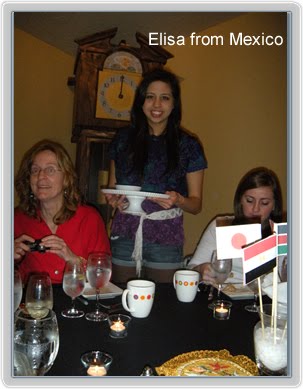 rican' looks like. To me, American is any and every culture, yet these students are proud of their heritage as much as they love Alaska.
Most students commented about the adjustment to a "small town" and "cold", laughing about what these terms meant and how their families back home couldn't conceive how cold it gets in Homer and what snow is like. It wasn't necessarily an easy adjustment. All of the exchange students who were at the dinner skied on Homer High School's cross-country ski team and a couple had raced in regionals earlier that day, wrapping up their season. Their willingness to try something different that would push them out of their comfort zone is one thing that sets exchange students apart from others who don't uproot themselves for a year. Without that willingness to experience things, it would be a long, long year.
Thursday, January 6, 2011
A Note From Your Alaska Blogger
Many of my regular blog readers noticed that I took a few months off last fall from blogging. After three years of nearly weekly blog entries, it was a radical departure from my norm. I was happy to hear (actually!) that my blogging was missed, as I got emails, Christmas cards and word-of-mouth messages wondering what was wrong or what was going on.
Well, what was going on (now that I have a chance to breathe!) was LIFE! It seems that with teaching college classes, homeschooling my kids, having an exchange student (in high school...in sports...), and teaching and directing the faith formation program at our church, that all my time was tied up. From mid-August through October the harvest takes up any spare time I might have. Berries begin to ripen in August. This year the raspberry crop was tremendous and we had so many in and around our yard--many more than we could ever pick--so if I had 20 minutes here or there I would dash out and pick. Or else we would head out for a weekend of camping and berrypicking somewhere on the Peninsula. Or the onions, carrots, and potatoes were ready to pull in before the ground froze. Then we had 800 apples to harvest from our 2 apple trees. Even once the things were picked, I didn't have enough time to process them, so once everthing was 'in' I began to clean, chop, freeze or can.
There was a moment back in November at about 10 a.m. on a Thursday morning that I felt a tremendous sense of relief: I sensed I was over the worst of the craziness of the fall. Everything from the harvest that needed (really needed) to be 'put up' was put up. I snuck in a blog entry that day, excited to be 'back.' Yet I only managed to write another few entries between then and now. Life keeps happening.
When we first moved to Alaska the pace of life was slower. We didn't have a lot of friends, we lived way out of town so didn't run in and out much, the kids weren't in so many activities and neither were we. At the time I just regarded that as "life in Alaska," but now I know better. Life in Alaska can certainly be as busy and crazy as life everywhere else in the world. Pace of life is a choice of activities. Some people complain that there's not that much to do in Homer. Yet for us we have to choose between two or even three different activities going on at the same time some days. Do we go to this movie fundraiser or this sporting event or head out of town for a trip with friends? Or do we go to this concert or just take a few hours off and go home and read a book and chill? Many times I have to drop off one kid, pick up the next, run them home, drop off another kid, then start picking them up, glad to be home by 8 with the running done for the day.
On top of the busy-ness is the 'normalcy' of Alaska now. It has taken me three years to get to the point that what happens here is the 'norm' that I compare the rest of the world to. When I went back to Michigan for Christmas it was Michigan that was different, not Alaska that was different. And yet the biggest difference that I noticed was just the prices of things (waaaaay cheaper!), and everything else just seemed like life...in a different place.
My apologies for leaving you out cold for three months with no news on life from Alaska. If I do it again, it is probably for lack of exciting things to blog about (9 months of the year it's all about school stuff) or lack of time to write. I try not to be repetitious, and we have our favorite spots we go back to and enjoy again and again now. No need to bore you with that again...
Meanwhile, thanks for reading, thanks for your comments, and enjoy!
Well, what was going on (now that I have a chance to breathe!) was LIFE! It seems that with teaching college classes, homeschooling my kids, having an exchange student (in high school...in sports...), and teaching and directing the faith formation program at our church, that all my time was tied up. From mid-August through October the harvest takes up any spare time I might have. Berries begin to ripen in August. This year the raspberry crop was tremendous and we had so many in and around our yard--many more than we could ever pick--so if I had 20 minutes here or there I would dash out and pick. Or else we would head out for a weekend of camping and berrypicking somewhere on the Peninsula. Or the onions, carrots, and potatoes were ready to pull in before the ground froze. Then we had 800 apples to harvest from our 2 apple trees. Even once the things were picked, I didn't have enough time to process them, so once everthing was 'in' I began to clean, chop, freeze or can.
There was a moment back in November at about 10 a.m. on a Thursday morning that I felt a tremendous sense of relief: I sensed I was over the worst of the craziness of the fall. Everything from the harvest that needed (really needed) to be 'put up' was put up. I snuck in a blog entry that day, excited to be 'back.' Yet I only managed to write another few entries between then and now. Life keeps happening.
When we first moved to Alaska the pace of life was slower. We didn't have a lot of friends, we lived way out of town so didn't run in and out much, the kids weren't in so many activities and neither were we. At the time I just regarded that as "life in Alaska," but now I know better. Life in Alaska can certainly be as busy and crazy as life everywhere else in the world. Pace of life is a choice of activities. Some people complain that there's not that much to do in Homer. Yet for us we have to choose between two or even three different activities going on at the same time some days. Do we go to this movie fundraiser or this sporting event or head out of town for a trip with friends? Or do we go to this concert or just take a few hours off and go home and read a book and chill? Many times I have to drop off one kid, pick up the next, run them home, drop off another kid, then start picking them up, glad to be home by 8 with the running done for the day.
On top of the busy-ness is the 'normalcy' of Alaska now. It has taken me three years to get to the point that what happens here is the 'norm' that I compare the rest of the world to. When I went back to Michigan for Christmas it was Michigan that was different, not Alaska that was different. And yet the biggest difference that I noticed was just the prices of things (waaaaay cheaper!), and everything else just seemed like life...in a different place.
My apologies for leaving you out cold for three months with no news on life from Alaska. If I do it again, it is probably for lack of exciting things to blog about (9 months of the year it's all about school stuff) or lack of time to write. I try not to be repetitious, and we have our favorite spots we go back to and enjoy again and again now. No need to bore you with that again...
Meanwhile, thanks for reading, thanks for your comments, and enjoy!
Ice, Ice, Ice!

One of the standards of living in Ho
 mer is the ice. Oftentimes for months at a time there will be 6 inches or more of ice coating all the side roads on the 'bench' (below the ridge that rises above Homer). This seems to be caused by a combination of factors. Because we are at sea level, the temperatures often warm up at some point after it snows (or else it rains instead of snows) and the snow begins to melt. Also, all of the roads below the bench are south-facing and sloped. Water runs off the ridge, heading to the sea, and it freezes into thick swaths of ice. Oftentimes there will be fields covered in thick swabs of ice as the water ran down the slope and froze.
A few days ago my husband and I walked the loop near where we live, with trails connecting between roads. What is normally a boggy trail was transformed into a thick ice trail. Luckily we had our Yak-traks on, otherwise we would not have been able to make it without a number of falls, especially as there were uphills and downhills. And in some places the ice encased the bases of the trees, several feet thick.
Most of the winter our driveway looks much like this: a sheet of ice that requires careful maneuvering and caution and that gets covered with stud skid marks, indication that our studs are doing their job.
When I first moved to Homer I swore I would never live in this area where the roads are so icy, but here I am, living on the bench and dealing with ice daily. It is not as bad as I thought it would be. One learns to live with ice as one learns to live with snow or the cold or whatever other conditions face us!
Tuesday, November 23, 2010
Visit to Barrow
 As principal at the local high school, my husband gets the opportunity to travel with sports teams, acting as the official liaison for the district and preventing problems that might occur with students. Last week when the wrestling traveled to Barrow for 4 days, Douglas ended up going with.
It was a process getting there, with a cargo plane ride from Homer to Anchorage to Prudhoe Bay to Barrow (the flights up to Prudhoe Bay were full, shuttling oil field workers back and forth). Just a few days before Douglas got there it was 50 degrees below zero, but he lucked out and it was 15 to 30 above the 4 days he was there--the same temperatures as Homer. The current principal at Homer High School was principal in Barrow for two years. He said that when it was 50 below, the two block walk from the airport to the high school was the longest walk he has ever taken in his life. Douglas was prepared with long underwear, coveralls, boots and all sorts of cold weather gear and was fortunate in not needing it.
The sun didn't rise the whole time Douglas was there, and the brightest it got was a mid-evening twilight (I lightened my pictures so they represent how dark it was). The school took the 6 or 7 wrestling teams that were there on a tour of the town. Pictured above is the sign at the highest latitude of land in the U.S. Behind i
 t is the Arctic Ocean. The football field was under snow, which was a bummer because we've heard much about this high-tech wonder.
All of the buildings are built on stilts to prevent the thawing of the permafrost. Douglas described Barrow as "Any American town, a little run-down fishing village." There are 4 schools serving the 5000 or so people in Barrow: 2 elementaries, a middle school and high school. When sports teams come the high school houses them and feeds them, slightly alleviating the huge expense of getting there (approximately $1000 per ticket round trip, Homer to Barrow).
There was one store, with clothes, groceries, 4-wheelers and everything else sold in it. Prices were about 20% or more higher than Homer (which is already 20-50% higher than the Lower 48. For example, a can of soup was $3. A 5 pound bag of fresh apples and oranges was $14. A small container of laundry detergent was $15. Electricity,
 on the other hand, is relatively cheap because they pump the natural gas out of the ground and right into their generators.
 As they were leaving, one of the coaches asked a local if they had some muk-tuk the kids could try. The lady said a whale had just been harvested and the blubber had been shipped in. She gave him a 10 pound box of muk-tuk. He shared it with the staff back at Homer. It was very chewy--impossible to bite off a piece in fact. A lady mentioned to me that her husband worked in Barrow and he would chew on two little pieces of muk-tuk and it had enough energy to last him for hours (despite that he lost 40 pounds while working in the 50 below weather). What you see pictured below is about four inches long. The dark part is the whale skin. I chewed on a piece like this for a minute or two this afternoon. Seven hours later, even after eating lunch and dinner, the taste of the muk-tuk is still in my mouth. It reminds me of a buttery flavor. I can understand how this would be a staple in the Eskimo diet. It is pure energy and it lasts a long time. I can also see why the Eskimo's teeth would get worn down from such a diet.

Monday, November 22, 2010
Ice Skating Beluga Lake

In 3 years of living here, we've never gotten to Beluga Lake in Homer during the 3-5 day window in early winter when the lake freezes over and the ice is perfect for skating. This year, despite having to play musical skates (both our kids outgrew their ice skates, plus we have our exchange student to fit with skates), I was determined to make it out on the lake to skate.
As you can see, it is a good sized lake, and nearly the entire surface was smooth as an indoor skating rink. It was glorious, skating along, completely free, with the sunshine and mountains and a huge expanse of smooth ice. We went skating every day for the past 3 days, and at times there were over 100 people on the ice, but it never felt crowded with so much space to spread out.
From here on out, we will make sure we get out on the lake for the few days a year when it is skateable!
Subscribe to:
Posts (Atom)