Friday, August 14, 2015

Jakolof Bay Revisited Once Again

I have found Jakolof Bay to be a great starting point for across-the-bay adventures.  On a recent weekend there, we were treated to 70 degree weather, sunshine all the way and nearly perfect calm--a rare combination. 

Tidepooling a -4.6 tide uncovered some awesome finds, including a giant pacific octopus and a Christmas anemone eating a fish.


The Jakolof Dock and beach at a low low tide


Tidepooling involved moving aside the kelp to find cool things

A pincushion with unusually long spines

An anemone made its home in an old clam shell


Thanks, Jen Aist, for a picture of this anemone eating a fish!

With the tide extremes, low and high tides were very different, and made a difference in how many boats could fit at the dock without going dry during the low tide.


The dock at high tide--no beach!
Our tidepooling area is completely covered in water at high tide.

And a video of the dock and beach; lots of beach at this low tide.

The bike ride to Seldovia to get ice cream reminded me that it is not an easy ride--lots of hills! It sure is fun going down those said hills though!!


A great view of Grace Ridge from the Seldovia road

Looking towards the MacDonald Spit by Jakolof Bay from the Seldovia Road
The kids biked to Red Mountain (no pictures unless they decide to share them with me!). They said it was rough. As Denver put it, there were about 20 places a car would not have made it. He couldn't believe just 4 or 5 years ago we drove in a truck all the way up to the base of Red Mountain, and it was a pretty good road. The stream has taken over the road so the road is now the streambed. Since it is a dry summer, there was just a trickle, which the kids were happy to walk in as they walked their bikes because it was a hot day. 

It took them 2 hours to bike/walk to "the bridge" at the base of Red Mountain. From there they ditched the bikes and explored, finding a 30-foot-deep mine shaft. The ride back was an hour, testament to the effect of the 1500 foot elevation gain from the dock to the mountain. They enjoyed their expedition and want to do it again, spending more time up there to explore.

The folks from Anchorage who joined us kayaked from the Spit to Jakolof. They forgot their map so only had a GPS, and the tide was coming in and the afternoon wind came up, so it made for a seven hour, 19 mile paddle. While they were experienced paddlers, they had never kayaked in Kachemak Bay before so without the map they couldn't tell if islands were bays, which made it a bit longer than if they'd known the route. But they were pleased with the challenge. I don't hear about many folks who paddle from Homer across the bay since it is 3 miles from the tip of the spit to Gull Island, and then more to mainland past the island. They did it though so kudos to them.

All in all, in was an amazing weekend to be across the bay!

Friday, August 7, 2015

Dance of the Sandhill Cranes


For whatever reason, the sandhill cranes have been hanging out a lot in our neighborhood this past week. Nearly any time I walk down the road, two, three or four of them are gathered in someone's yard or driveway. I feel bad when I disturb them, but usually they just stalk off. Occasionally they will squawk and ponderously take flight, only to land in the next yard down.

Like moose, bear, eagles and other exotic animals we have in Alaska, I have come to almost take sandhill cranes for granted. They are part of the scenery, but their loss would be noticed. The evening fly-overs with the distinctive croak-squawk are almost as regular as the Homer Air flights coming in each night. It is fun to look for the first ones in the spring, and then to keep an eye out for the little colts once the hatch happens. So whatever has sent the cranes our way this August, I am enjoying them!

Thursday, August 6, 2015

The Great Kale Heist

August brings harvest craziness. Raspberries, service berries and black currants are all ripe in my yard. The strawberries are finally done. A couple days ago I blanched and froze spinach greens and beet greens (the beet greens only because I was thinning them--not full harvest yet). That day my husband commented that my kale really needed to be picked. If he's noticing it, then it must be time. So today was the day. In the course of picking the kale I realized I hadn't thinned the turnips, and in thinning the turnips I discovered masses of root maggots on them, so they all had to go. Bye-bye turnips. I have enough to make a couple batches of pasties, which is why I planted them. And then I realized I hadn't thinned my carrots either, and they needed it, so I pulled up the little ones and will make one of my daughter's favorite's: carrot top and quinoa soup. Yum!

After I got the turnips in and the carrots picked, I finished picking the kale and began the production. One exciting development is that I no longer blanch my greens by putting them in boiling water. My aunt steams hers and I have found that I can do a much larger quantity in the same amount of time, and it is much less messy and likely takes fewer nutrients out of the greens. At 3 minutes per batch, I was able to blanch all of this in 30 minutes.


Tub stuffed tight full with kale
Kale in the sink being washed. Love the huge mud room sink--perfect for such jobs!

Washed kale in bucket right by the stove--ready to pop into the pots
Three pots for steaming and two tubs of ice water for chilling ready to go

Steamed kale with the water squeezed out of it, waiting to be frozen

Steamed kale spread out on parchment-lined baking sheets. They get frozen like that, then taken out and packaged to make it easier to pull them out of the package frozen.

Bags of kale--ready to go into the freezer!


 The whole process (without the turnip and carrot distractions) took about an hour from picking to into the freezer. I suspect I have a few hundred dollars worth of kale there, though I don't have the courage to actually look at the price of kale in the grocery store and usually just close my eyes and grab it if I really am wanting some kale mid-winter when my supply has run out.

Last year my 5 bags of kale, like I have here, lasted me till January, going into daily smoothies and soups. This year I'm thinking I'll have more as it is only early August yet. As I like to say, food rarely goes bad in my house as I make sure I use it before it goes "over the hill."


Wednesday, August 5, 2015

Bringing the Boats In


Yesterday as I was driving into town, I noticed six boats in the queue on Kachemak Bay to get dry docked at Northern Enterprises Boatyard. The only reason there are ever boats in that spot is if they are coming in or heading out of the boat yard. Salmon fishing is mostly over in Cook Inlet (there may be some emergency openings, but the regular openings are done), and it was a high tide. I didn't get stopped by a crossing boat, but on the way home an hour later, a boat made the crossing from Kachemak Bay, across Kachemak Drive into the boat yard. It was just a few moments and I was on my way. Only the largest boats get dry docked, and the ones that need to be worked on over the winter. 

From all reports I've heard, it was an underwhelming fishing season in the inlet; terrible is the word most commonly used. With budget woes already looming with the state's slashing their budget due to declining oil revenues, a poor fishing season is going to be a hard hit to the state as well. I'm feeling for the fishermen.

Tuesday, August 4, 2015

Getting in the Hay

A nice 4-day window of sunny weather the other week gave my uncle in Ninilchik the break he needed to get his hay cut, fluffed, baled and into the barn. When he cuts the hay we go on notice, planning to run up there two to three days later to help pull the bales off the field and get them into the barn. Seems like most folks have gone to the large round bales which are less sensitive to moisture, but less portable as well. Round bales can be done with one person on tractor, while the square bales are kicked out of the machine and sit around the field. Each one needs to be picked up, thrown onto the flat-bed hay wagon, stacked on the wagon, driven to the barn, thrown off the wagon and then stacked. This year they pulled in 1200-1400 bales, and with the number of times each bales is lifted and thrown, one wants a big crew to lighten the load!

Of course haying is always done in hot, sunny weather (otherwise we wouldn't be haying!), and the hard work of lifting and throwing 35-45 pound bales makes for a sweaty enterprise! Constant close contact with the hay makes one feel itchy and icky, so the shower at the end is the biggest treat.

Here is a short video of our hay stacking coordination in the barn on our last load (hence the very fatigued movements!). Teamwork and communication are essential, and tempers get short as folks get tired. This year we got in 900 bales in 6 hours with a crew of varying sizes. With a 5 p.m. start, that meant we ate a brief dinner on the field rather than heading in for a feast afterwards, which is what we normally do. They baled and pulled in the rest the next day, though luckily some folks bought the bales and took the discount and pulled the bales off the field themselves. 


There is always a sense of accomplishment when we are done haying, along with appreciation of an amazing workout!

Wednesday, July 29, 2015

Backpacking the Ptarmigan Trail


Thanks, Alisa Aist, for this beautiful photo of Ptarmigan Lake

This summer has been a series of last-minute trips since we're never quite sure when Aurora and Elisa have off from their internship with the Center for Alaskan Coastal Studies. The Ptarmigan trip was the first, back in June. The girls had Friday and Saturday off; Thursday evening the girls begged for a backpacking trip--somewhere! Any of the shorter trails are also less scenic, but this trail had been on my to-do list for a few years since we did a day hike to the lake and back while camping along the Seward Highway in the Ptarmigan Campground. It is 3.5 miles to the lake over gradual terrain (e.g.:  not a mountain pass!). It has been a couple years since I'd backpacked and I'd been having back issues so I figured this was do-able. Off we went despite a weather forecast for rain!

Besides going across Kachemak Bay to Kachemak Bay State Park, the nearest good, long hikes are in Cooper Landing, 2 plus hours from Homer. I consider that the biggest downfall of living here. Normally if we make a trip of 3 hours we want to go for the whole weekend, but that is more restrictive in finding camping spots or expensive cabins/hotels. So I threw out that attitude and that has allowed us to do the hikes we've done this summer.
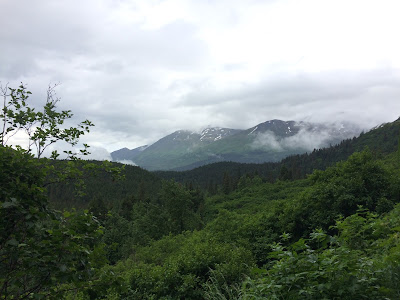


View of the hike, about mile 2.5 (picture by Alisa Aist)

Ptarmigan is just over 3 hours away, a few minutes past Moose Pass on the way to Seward. The trailhead parking lot is adjacent the campground. Our packs were all loaded and ready to go so we just got on our footwear of choice and off we went. The first half mile or so is a very well developed trail, smooth gravel. At a turnoff it continues to follow Ptarmigan River, a gorgeous rushing glacial stream. I have special affection for this trail. We camped at the campground 10 years ago when we visited Alaska, before we moved here. I recall going a little ways along this trail and it was quite rough and seemed immensely remote. Now it seemed positively tame.
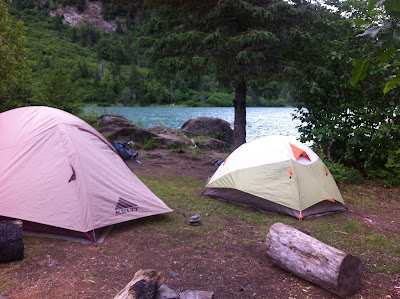


Beautiful campsite, with loons calling from the lake
An hour and a half got us to our campsite, a level area jutting out into the lake with rocks and spruce trees creating an intimate and peaceful setting. Some folks were fishing and had a hammock strung between two trees, but they were only day use so we set up our tents, pulled together day packs, and took off for the head of the lake, another 3.5 miles. There are 4 campsites along the lake, three of the clustered at the end we were at and another at the far end. There was even a bear container for food and smellies, and an open air outhouse:  the toilet with no walls.
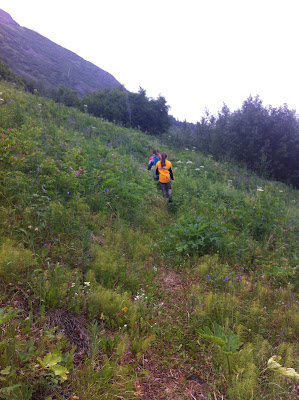

The trail along the lake traversed across mountain meadows


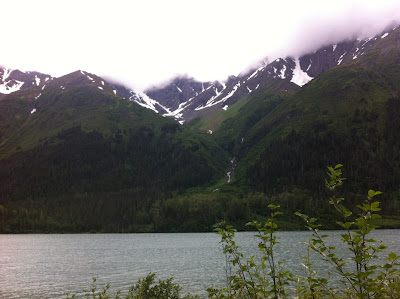
The 3.5 mile long Ptarmigan Lake is hemmed in by mountains


Glaciers on the mountains feed the lake


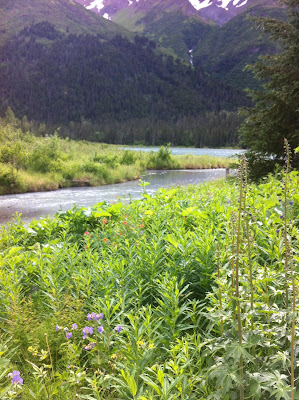
The river at the head of the lake, taken from near the campsite


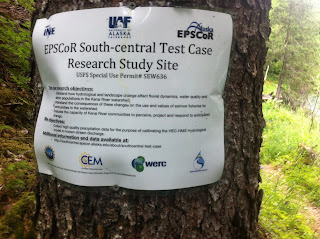
A study was being conducted along the lake

The equipment was wired off, probably with electric wire to keep the bears away


The hike to the head of the lake was uneventful and while it was scenic, I barely saw it as I was trying to keep up with 3 very speedy teenagers whose natural walking pace is far faster than mine. Occasionally they would stop to tie their shoes and I would catch up to them and catch my breath for a moment before they were off again. I'd been smart to insist on leading when backpacking in otherwise they'd have left me far behind.

Once back to the campsite the kids wanted to go explore. We could hear a waterfall nearby where the lake turned into a river. Turns out it was a rough trek to get the few hundred yards to the spot, but the wild rapids were worth it.

The kids looking towards the end of the lake where the river begins


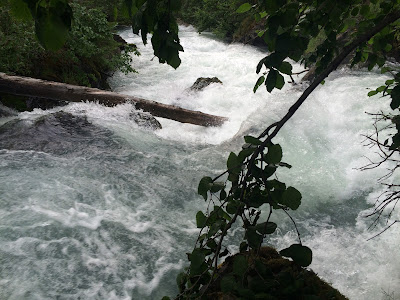
The calm, smooth lake instantly turns into a maelstrom the moment it becomes a river
 (photo by Alisa Aist) 

Bear scat along the first 3.5 miles of the trial was nonexistent; along the lake we saw 5 or 6 bear scats that were relatively fresh. I wasn't too worried about it. Later that evening after eating dinner in camp, I walked the few hundred yards through the brushy trail to the pit toilet. As I came up to the main trail from the side trail to our campsite, there was a movement about 15 feet from me, a rustle and I saw a black furry back melt off into the brush. I was like, "Helll-oooooo!" knowing it was a black bear and that if he/she was displeased with me being there I would already be toast. I opted to continue to the outhouse, making more noise than I had been before.  After returning to camp I was telling the kids I'd just seen a bear and the bear itself, a fairly large blackie, came into view along the lake trail, heading up-lake, away from us. Apparently he'd been strolling the main trail when I disturbed him; he took a detour and once I was gone he continued on his way up the trail. The next day when we returned to the trailhead there was fresh bear scat not far up the trail where there had been none the day before.

I know Alaskans who won't hike in the summer because they are nervous about encountering bear. I am aware of bear mauling people. My experience encountering bear in the wild has been that every time they have avoided me, oftentimes quite vigorously, running away at high speed. I also know that I have likely had more bear encounters than I've been aware of:  they are all over and most of the time they do not make their presence known; they just slip off before we become aware of them. If I hadn't been so close to this one and facing it, I would not have known it was even there.

The hike back was speedier than coming since we'd eaten our food and I'd offloaded much of my load onto the kids (why didn't I do that the first day?!). It had been raining so the extensive grass hanging over the trail was wet and we were soaked in short order, but it was warm and we were exercising so we were not cold. It was a fun trip, despite being less than 24 hours. It whetted my appetite for backpacking, though I recognize that I am limited more by time than anything else since there are so many awesome hikes I want to do and not enough time to do them all!

Tuesday, July 28, 2015

Skyline Revisited

Hiking the Skyline trail near the Kenai Wildlife Refuge between Sterling and Cooper Landing is like visiting an old friend. This is one of our annual hikes--treks we make a point to do once every summer. This year saw some new side trails forged to avoid challenging sections, a development I appreciate (better footing; safer) and dislike (confusing to know which one to take). Trail use has increased greatly on Skyline since we moved here 8 years ago, and what was once a single ribbon of a trail up the 3000 or so feet to the summit now has widened as people continue to search for firmer footholds along the side of the trail on the steep, gravel-covered inclines. This trail has not seen any "upgrades" in years. About 10 steps were put in about 5 years ago in one section, but besides that, this trail seems completely untended.

The views of Skilak Lake are always a treat, as are the many smaller lakes and mountains. Once one reaches the summit it can be continued along the ridgetop and then a descent to the Fuller Lakes, making it a point-to-point hike. That's on my to-do list someday!


I love this grove of trees about 2/3 of the way up, almost to the saddle

Near the top--the area that usually is snow-covered latest in the season. No snow this year.
The "orange box" at the top for signing in the accomplishment

Aurora doing her juggling thing at the top