Sunday, August 10, 2008

Caribou Lake Trail

I read a newspaper clipping recently about mountain bike trails in the Homer area, and they rated the Caribou Lake Trail as a 2 out of 5 (pretty easy!). This trail takes off of Basargain Road near the Village of Razdolna, so we have passed it many times, but never took the time to check it out. A couple weeks ago we decided that it was time to do it, so penciled it in for today. It is a 4-wheeler highway in the summer, and a snowmobile freeway in the winter. Since we didn't think the kids would be up for a 14 mile mountain bike ride, we decided to 4-wheel it. Good thing we did. We wouldn't have gotten very far biking!

It rained heavily last night, on top of raining a lot all summer, so we were expecting mud, but not quite as much mud as we got! The 7 miles of trail to Caribou Lake could be separated into 3 categories:
  1. Very muddy
  2. Boardwalk
  3. Well packed, nice dirt trail.
If it weren't for all this rain, the trail would have been mostly #3 and a joy to hike, mountain bike or 4-wheel. As it was, the mud was up to a foot deep in most places that wasn't boardwalk. The kids were a little nervous, and though I was mostly (!!) confident in the 4-wheeler's ability to get me through the muck, it took complete concentration and some muscling to keep the machine on the trail.
I would say the boardwalk was maybe 2-3 (??) miles of the 7. The nice, packed trail might have hit 1 mile in some high, well-drained spots. The remaining 3-4 miles was muck!
Since we've moved here we've seen probably hundreds of ATV's being hauled down East End Road to the Caribou Lakes Trail. I have noticed that all of them that are heading back in the direction of Homer have been very muddy! Now we know why. Here's a picture of me after our excursion today. The picture doesn't do justice to how muddy it was!

As for Caribou Lake, we were utterly unimpressed. People talk about it like it is a really incredible place, but it's a medium-sized lake with lily pads growing on one end and a virtual village of cabins surrounding it. The irony is that people go there to "get away", but they are surrounded by neighbors out there! Some of the "cabins" are nicer than many people's homes; other cabins have been in the family for generations so there is a sense of history with it.

It took us a little over an hour to 4-wheel 11 or so miles from our house to Caribou Lake. I will admit that we certainly felt like we were a long ways out--it was a long hour! I actually started to enjoy myself on the way back with the sun shining and despite my forearm cramping from keeping the gas lever pressed. I actually, in a perverse way, look forward to going out there again and exploring some other trails! Next time I'll wear muck boots so the waves of mud don't wash into my hiking boots!

Darkness Returns

Although we still have more daylight than the Lower 48, I begin to notice the return of darkness. We now have to turn our nightlights on, as it actually gets dark at night again. And last night I saw stars for the first time in months. I may have been able to see stars before now, but it has been such a cloudy, rainy summer that I haven't seen any. Plus, I'm usually asleep in the middle of the night when I might be able to see them!

Part of me is happy that there's not quite so much daylight--a more normal amount! Another part of me is sad because the return of darkness at night signals fall, going back to school and the impending "season of darkness". So it was with mixed emotions that I gazed at the stars last night.

Sunday, August 3, 2008

Low Tide Fun

Back in May I happened upon Bishop's Beach at a -5.5 tide, and said I was going to put the August low tides on my calendar (we were out of town for the June and July minus tides). Our entire weekend revolved around low tide activities, as we had a -4.1 for clamming in Ninilchik Friday, a -4.4 for tidepool exploring Saturday and a -3.4 Sunday for a 7 mile beach hike from Diamond Creek to Bishop's Beach.
Clamming is great fun, and a way to get very dirty! A party of 7 of us (4 shovels) dug 2 1/2 three gallon buckets of them in one hour. Denver and Aurora each got a few clams all by themselves (dig and grab), but mostly I dug and the kids grabbed. My goal for the day was to not break so many (they're a lot harder to clean), and my first 5 or 6 I broke when I grabbed them, but then I refined my digging and grabbing techniques and pulled out my clams unscathed. Most were 6-10 inches long, and the 3-5 inch ones we put back in the holes. Our regular Alaska fishing license covers clamming, and we're allowed 60 per day. Clam Gulch, once known for their clams, has been overharvested and you can't find more than 3-4 inch clams there anymore from what I hear.

It is the cleaning afterwards that is not fun! It took me three hours to clean my one bucket of clams, with Denver cutting off the necks and cutting them open, and Aurora helping gut them for awhile. All the while we dreamed of clam chowder to keep us going through the tedious process.

Tidepool searching the kelp beds during a very low tide on Bishop's Beach is like a treasure hunt. We saw a small jellyfish, shrimp, a couple live crabs in shells, many dead crabs not in shells, anemones, sea cucumbers, clam breathers, starfish of many sizes and jellies, among many other things that we didn't know the names of. The kids found it as cool as I did. The tide only gets low enough to expose those areas a handful of times a year, and from here on out I will adjust my schedule to try to be in Homer to visit the beaches during those low, low tides.

The highlights of the tidepool exploring:
  • Seeing a jellyfish and walking along with it as the tide brought it in. It was very cool seeing it pulse, and I never pictured them as being translucent blue.
  • Denver picked up a shell to take home, and 30 minutes later as we were heading back up to our car, a crab started coming out of it. Denver screamed and dropped it in the water, and it scuttled away.
  • Seeing a flounder (a flat fish like a halibut); it was nearly impossible to pick it out when it was still since it blended in so well.
We have been wanting to hike from Diamond Creek to Bishop's Beach for a year now, ever since we found out we could. We used a low tide as an excuse to schedule it in so that we would have firm sand to walk on (hopefully; we weren't sure what the beach would be like!). Although it was only a -3.4, a whole foot less than the previous day, we ended up seeing a great number a very cool tidepool creatures and plants.

Most of the hike was bordered by cliffs like these. It was easy walking on firm sand most of the way, especially for the kids and I with our muck boots. Doug has held off getting muck boots, and by trail's end his hiking boots were soaked.

The Sterling Highway gets as close as 40 feet from the edge of this cliff, and with global warming and higher sea levels, this cliff is being washed away. I have heard that in 25 years or so sections of the Sterling Highway will be washed into the ocean if current trends continue. That could definitely change the dynamics of getting to Homer!

Slime molds were the highlight of this hike, as seen in the picture to the left. We've seen 2 or 3 slime molds in all our beach walks in a year, and today we saw at least a dozen. They are fascinating in the patterns and colors displayed. This one has obviously been out of the water for awhile as the edges are rough rather than smooth and regular. The rock pictured to the right was amazing. It looked more like driftwood or I don't know what--but not a rock!

The only blip in our hike was at about mile 5 when I got stuck in some mud. We'd been going along on firm sand and pebbly rocks, but decided to cut across a little cove. I was following Aurora, who got sucked in a little, but when I followed my boots got completely mired and I had to take them off in order to pull them out. Meanwhile, the mud had overflowed into one boot, so I had a mucky mess. I decided to take both of them off and walked out of there barefoot. It was warm enough and all firm sand from there on out, so I just walked barefoot for another mile or so until my feet started getting rubbed raw.

A dead sting ray was the most fascinating and unexpected find of the day.

Once again Denver had picked up shells to take home, and this time the crab didn't start coming out till we were in the car! Oh no! Denver panicked, and it was hilarious watching his expression as he held a shell with a crab crawling out of it! If he dropped it, it would fall in his lap, and he certainly didn't want that!! I relieved him of it, and he carefully checked all his other shells for hidden invaders! Who would have guessed what fun low tides could bring??!!

Monday, July 28, 2008

Dipnetting

I don't really want to blog about dipnetting, but it is the ultimate "Alaskan" experience so I feel obligated to.

My cousins go dipnetting at the mouth of the Kenai River every year, and most years they seem to come back it seems just a few hours later with 30-60 salmon. Each head of household is allowed 25 salmon, and each additional person in the family gets 10. Our family of 4 could get 55 salmon. Figure at 7 pounds apiece, that would be 385 pounds of salmon we could can, freeze and smoke. It's free food, in terms of money, but it is costly in terms of equipment and time.

We tagged along with my cousin Kelli and her husband Todd when they went dipnetting Tuesday. We didn't know a thing, and we borrowed their (and my aunt and uncle's) equipment, so it really felt like going along for the ride. We had to buy an Alaskan fishing license for $24, which is good for all fishing for the whole year (just for Douglas). The best dipnetting is 2 hours before and after the high tide; we got there at 9:30, just after high tide.

The process: People have 10-15 foot poles with huge nets on the end. Everyone has chest waders on (and occasional wetsuits or drysuits) and they stand side by side, shoulder to shoulder, for maybe a mile or so up and down the beach at the mouth of the Kenai, Kasilof or Fish Rivers on the Kenai Peninsula (there are other places to go, I believe, but these are the most popular). They stand there and hold their net until a fish swims into it. Then they drag it ashore where they usually have someone who bonks it with a club, pulls it out of the net, bleeds it, cuts off its tail fins (state law), rinses it off and tosses it in a cooler standing nearby. Some people actually fillet them on the spot, but most people don't.

Doug and Todd were out there for 3 hours. Doug, standing near the shore with a net, didn't get any fish. Todd puts on a wetsuit and flippers and floats down the river, comes in to shore, then walks back upstream. He had the best day of anyone we saw: he got 7 fish. A few days earlier 68,000 fish went through the counter 18 miles upstream. The day before, 29,000 fish went through. So it's a guessing game of how many fish are going to come through the day you go dipnetting. We were not in luck, and though we learned a lot, I was very disappointed. We spent 5+ hours in the car getting to Kenai to fish, plus gas money, for no fish to take home. I'd had visions of filleting till the wee hours of the morning. Ha.

People from Anchorage take a week and they camp out, dipnetting every day. Diamond M Ranch is packed in July. They have a nice setup: a fish cleaning station and free freezer space, and they're only a few minutes from the river. Most people camp on the beach at the mouth of the river or at campgrounds all over the area. The stores are overflowing with people, and smokers, nets, waders, coolers are hot items. There is a craziness to life around Soldotna and Kenai in July as the population of Anchorage descends upon them.

Now we have to decide if we're going to stay in Alaska long enough to make the investment in dipnetting equipment worth it!

Garden Update


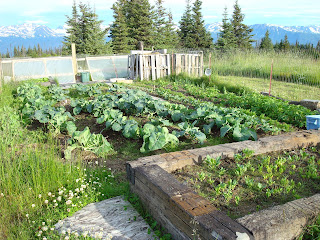
I have been meaning to give garden updates before this, but haven't been around to snap a picture & blog--or else have been too embarrassed by how pathetic the garden has looked.

One month ago, at the end of June, I didn't know if I would get anything out of this garden. My cabbages, broccoli and cauliflower (C-B-C) were dying left and right, you could hardly see most of my kohlrabi plants, and my spinach and lettuce had sprouted but weren't growing. While it has been a very cool summer (some say the coldest since 1952), the garden is finally looking respectable.

My C-B-C died and I replanted 3 times. I ran out of my own plants so ended up going to the greenhouse and buying some. I'd been so careful to label each brand and type of plant, but after all those replantings, I was just throwing things in wherever there was a space. I have 70 C-B-C plants now, on last count, though I will just have to wait and see how many of each I get!

My spinach, seen in the raised bed in the foreground, is pathetic looking still. I put compost in the bottom, but then put regular dirt on top of it and didn't mix it up. That is how everything in the garden would be doing if I hadn't added 6 inches of compost/manure to the top last year. The romaine lettuce in the bed on the other end has finally begun to grow, after repeated fertilizing and lots of rain. We now have as much lettuce as we want to eat from that, and it is delicious!

In my coldframes, my zucchini is doing very similar to the spinach: small, pathetic plants (the soil is the same: hard clay when dry; muck when wet). However small the plants, they are loaded with blossoms and I noticed my first 2 inch zucchini on a couple days ago. Since it has been so cold I've left the wooden ends on all this time. My daughter asked me a few days ago how the blossoms were going to be pollinated. Good question! Now the boards on the ends are off and I'm hoping the bees come to visit!

All my plants (carrots-peas-onions-potatoes) are now pretty much on schedule and looking vital and healthy. I doused the bases of the C-B-C and kohlrabi in fish gurry yesterday to ward off fly larvae. It has rained for a couple weeks and now it is sunshining so that's the best recipe for success I think. Nothing much seems to produce till August anyways, and then we'll have to eat fresh stuff like mad!

I turned my compost for the first time this summer (I know, you're supposed to turn it regularly to give it air, etc. etc.) and it was HOT! Some shredded paper I put in there within the past week was browned--as in slightly burned! So despite not turning, it will still turn into compost! I have put in rotten barley, horse/cow manure, grass clippings, straw, household vegetable scraps, shredded paper and salmon leftovers/eggs (raw-after filleting). As you can see from the picture, I have a second compost bin started (as of today!). My other one keeps getting filled up, and I am discovering areas of the garden that are going to need significant infusion of "good stuff" for plants to do well next year!

The horsetail isn't too obvious in this picture, but it is an annoyance. It is solid between my rows of C-B-C, though I have pulled it when it is near the base of the plants. The other side of my garden, that is not in hills, is staying relatively weed free after 2 or 3 intensive weeding sessions. Someone told me to use a hoe to chop up the horsetail, time and again, and it will stop coming back, but my vegetable plants are so large now I'm afraid I'll damage them while doing so. And plenty of other gardeners have told me to give up on the horsetail, so I don't worry about it too much (after all, I'm sitting here blogging about it rather than out there weeding!!)

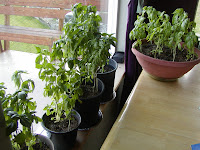
My basil is going gangbusters in my house, and my window sills are covered with them. I have one plant each in the little 3x3x3 planters (2 flats full, plus 5 big pots with 5 plants each), and amazingly, they are still growing and producing! For awhile I kept them too moist and they started getting the wilts, but now I let them get quite dry before I water them. This has been my greatest gardening joy of the year (fresh pesto--yum yum!), and next year I'm going to grow more greenhouse plants in the house. I want fresh veggies--and the plants love our sunny window.
If I had to do this over again,
  • I would have probably planted later (my first planting was the last week of May), though most years that would have been ok.
  • I would have had plant covers for my plants (I didn't round up enough milk cartons to cover all my starts until my third planting), I would have taken off the caps and just left the cartons on till the end of June rather than taking them off and back on each day.
  • I'm still out on whether I'll do my starts or just buy them next year. It is a hassle to start, and by time I buy starter soil, not much cheaper than just getting plants.
  • I would have made sure I put compost/manure over the whole garden last year (I missed a few sections and the plants are suffering in the clay).
  • I would have started my second compost bin sooner to take advantage of more grass clippings and other compostables.
  • I would also have fertilized sooner and more often.
  • A bunch of my plants suffered at one point when they got too dry (didn't get watered for a few weeks), and some of them died. I would have watered immediately upon coming home, rather than weeding for 3 days and then watering.
But this is all live and learn, and part of the fun. I keep saying it's all a grand experiment, and people keep telling me it's not an easy thing to grow a garden in Alaska. We don't have too much invested in it, so I keep convincing myself there's no great loss (besides my disappointment) if we don't get anything much. That was my attitude gardening in Michigan too, and there we had bounty beyond all words, with the joy of filling up cupboards and freezer, giving away to everyone we knew and selling at a farmers market to boot. If I ever move back to the Midwest and garden, I think I'll be in awe at how easy it is to grow things!!

Wednesday, July 23, 2008

Glacier and Wildlife Cruise


Everyone I've talked to who has taken a glacier and wildlife cruise out of Seward has said it was well worth the time and money, so, on impulse, we decided to do one out of Valdez since we were "in the area!" It was very close to the Chilkoot Trail as a highlight of our trip, and I think the memories of this cruise will probably last longer than the Chilkoot for it's "coolness" factor. I think we may have been the only Alaskans on the boat; there were people speaking other languages, and the guest book showed a spattering of people from all over the U.S.

We went on a 9-hour Stan Stephens cruise out Port Valdez to the Columbia and Meares Glaciers, and then back by Glacier Island and Bligh Reef. Meals were provided, and the food was delicious! I don't have the chance to say that often about mass-produced food, but the Oreos for dessert were my only complaint!

These two Stellar Sea Lions are comfortable on Buoy #9. At times there are up to 9 sea lions on this buoy and it sinks, as the sea lions are 650 lbs. (females) to 1200 lbs. (males).

Columbia Glacier is behind 2 miles of floating ice, so this is as close as we could get to it. Here the water is only 30 feet deep, but where the glacier calves the water is 1500 feet deep. The different colors of ice indicates how compact the ice is--the more blue, more compact the ice. The air was cold and I put on my winter hat and gloves and piled on sweatshirt and jacket as we drifted near the bergs.
The six hour cruise only goes to the Columbia Glacier. We went on to the Meares, which was much more impressive, and, amazingly, is one of the few glaciers in the U.S. that is growing (they listed 2 others in Prince William Sound that are growing as well; they don't know why).

Visiting Meares was one of my top favorite glacier visits. We didn't see any huge calving (when pieces of the glacier break off and fall into the water), which was disappointing, but it was still incredible hearing the loud, sharp creaks, snaps, pops and groans of this glacier. There were harbor seals on ice floes all around us at the base of the ice. Once again, the immensity of glaciers astounded me.

I'll be honest, I went on this cruise to see the glacier calf, and if I got any wildlife out of it, then that would be nice. Turns out the wildlife was spectacular. This humpback whale breached 6 or 7 times right next to our boat. Next time I won't spend all my time trying to get a video of it--I'll just watch it and go "wooooow!" with everyone else. My video clips show lots of splashes! There were 3 whales in this area off Glacier Island, and it was funny because although there were dozens of sea lions lounging and playing on shore right by the boat here, all eyes were on the water looking for the whales.
This is a video of the Dall's Porpoises, one of my favorite parts of the cruise. We saw them playing in the water in the distance, and pretty soon they were swimming with the boat (they can go up to 35 mph; our boat went about 23 mph most of the day). I was upstairs and didn't get down to the outside deck in time to see them and was so bummed, but when they came back I was ready! As we watched the porpoises play with the boat, we noticed some incredible jellies? jellyfish? floating in the water. They were all sorts of colors, shapes and sizes, and the water must have been so clear for us to see them.

Near the end of the day as we headed back into Port Valdez I saw a dark gray dorsal fin cut the water next to our boat. I was going to call out to the captain and ask him what it was, but it disappeared too quickly. It reappeared again briefly. When we asked the captain about it he said it may have been a salmon shark,which normally only surface once or twice.

The sea otters were too numerous to count, and were seen floating along with the babies on the belly of the parent. We saw a black bear, a Sitka black tailed deer with its baby, an eagle sitting in its nest, puffins and other seabirds. We saw a harbor seal gulp down a fish, and we saw fishing boats nearly swamped as they pulled in netloads full of salmon. It was just an incredible day. OK, I guess I do have a whale breaching video--slightly more than a splash since they go so fast!
And here are some sea lions playing and hanging out. Enjoy!

Valdez, Alaska


Once again, we decided that "since we were in the area" we ought to go check out Valdez. It was only 111 miles out of our
way (one way!), to get to Valdez from the Tok Cutoff, our turnoff towards Anchorage. From Homer it would be about a 12 hour drive. We spent 1 1/2 days in Valdez, and it is high on my list of places to return to. Since my camera was back in operation, I shall return to the photo journal format!

The Worthington Glacier barely gets mention in my Mileposts, but it was very neat because 1-it was deserted! The day was so yucky no one was around and 2-we could hike right up to and on it! The picture on the upper right is the big picture (that we took 2 days later on our return trip; it was covered by clouds the day we visited it). The picture on the left of the kids at it was down the lefthand arm near the terminus. I've seen so many glaciers lately, and I see them everywhere I go in Alaska, but this was our first time so close to one. I was struck by the sheer immensity of it. We felt like we were close to it, but it was still quite a hike up, then down over the moraine, and then you're standing right next to it and the ice just soars off way above your head into the clouds. Wow. It is on the drive from Glennallen to Valdez, just before Thompson Pass.

After Thompson Pass, about 12 miles out of Valdez, the sheer cliffs of Keystone Canyon rise above the road and river. Two incredible falls drop down from the mountains above it: Bridal Veil Falls (shown here) and Horsetail Falls (Seems to me there was another one, but it is not on the map. Could have just been rain runoff.). This area has a lot of history as it was the first glacier-free route from Valdez to the interior.

The Trans-Alaska Oil Pipeline roughly follows the Richardson Highway, so every so often we caught glimpses of it. In some places it goes underground, but where the oil would warm and melt the ice in the tundra it is above ground. The Alyeska Marine Terminal in Valdez (pictured here) is where the tankers fill up with oil after the 800 mile journey across Alaska from Prudhoe Bay. This is pristine Prince William Sound, and as we traveled around viewing wildlife on the cruise the following day I could picture the horrific mess of oil covering the animals, water and shoreline. Now the supertankers have tugboat escorts through the Sound to help stop them quickly if there is risk of colliding with an iceberg. The glaciers are calving often, so there are many icebergs scattered about that make this a very real threat. It takes the tankers over a mile to turn, and more than that to stop.

My sense of Valdez was remoteness: the town itself got 500 inches of snow one year recently, and the nearest town of any size is Palmer (near Anchorage), nearly 6 or more hours away via a mountain pass where they get even more snow (100-200 feet in some places in the mountains). One can also get there by boat, dodging all the fishing boats and glaciers. I could see making Valdez a destination vacation, and judging by the number of RV parks in town (they were all packed, despite high gas prices), many other people do too. There were hiking trails and other glaciers to explore, museums to visit and restaurants to try. Each town has its own "feel" or atmosphere, and I something about Valdez struck a chord with me. We often ask ourselves "Would we want to live here?" as we travel around Alaska. This is one of the places I think I might say yes! I'm a bit leery of all that snow, though!!