Sunday, November 9, 2008

40 Year Ice Skating Party Tradition

When my aunt and uncle moved to Alaska 40 years ago they started a tradition of having an ice skating party every year that the ice froze smoothly enough to skate. This year conditions were perfect when the ice froze, creating deep, smooth ice, and today was the day of the skating party.

It was snowing heavily when we left home, and the wind was blowing the snow horizontally. I was sure skating would be canceled in such weather, but to my surprise Delores said the weather was fine in Ninilchik--no rain, no snow--so we decided to make the 1 1/2 hour drive to join the skating party tradition. We went from snow at home to rain in Homer and back to snow as we headed up the hill out of Homer, then back to rain again until we hit Anchor Point when all precipitation stopped and the roads were dry (whew!).

The lake is 6 miles out of Ninilchik down Oil Well Road and then some bumpy dirt roads (unmaintained, so luckily not too much snow yet!). Delores & John used a piece of plywood held in front of the 4-wheeler and made 8 swipes around the lake on Wednesday to clear the track you see in the picture. It is a .4 mile loop around the lake, and the kids and I skated for 3 hours today, so I wonder how many miles we went!! Actually we could (and did!) skate anywhere on the lake because the snow wasn't very deep, and it was fun to "make tracks" in the fresh snow.

We had a fire going and a spread of food, including the Alaska standbys of moose dogs (as in "hot dogs") and salmon dips and salads. It was a breezy day, but not so cold that we were uncomfortable. I wasn't sure how we'd hold up being on an exposed lake all day, but what with the exercise of skating and occasional hot drinks, we were toasty all afternoon.

The kids were in skating heaven for 3 hours, playing tag, shoveling paths in the snow, eating desserts and basically hanging out on skates. I've skated ponds before, but never a whole lake, so this was a real treat. I will admit, I am sore, though I'm just itching to get back on skates and go some more!

As a side note, my kids were out with friends on Beluga Lake in Homer this past week and they tried an experiment (the dad--not the kids!). There were large air bubbles near the surface in the ice and Don poked a hole in the ice to the air bubble and quickly put a lighter to the hole. Each time a flame shot up, sometimes as high as 3 feet! Apparently the rotting vegetation in Beluga Lake gives off methane, which gets trapped in air bubbles when the water freezes. Thus the spectacular side-show! I want to get down there and try it one of these days. If I do I will treat you to a picture of this on my blog!

Saturday, November 8, 2008

Hauling Supplies to Razdolna

Well, it's a beautiful Saturday in November, and we're spending half a day hauling supplies out to Razdolna.

Since our little Russian school is down 5 1/2 miles of gravel roads, the Kenai Peninsula School District which it is part of will not send it's delivery truck to school. All water, paper, shelves and other supplies are dropped off in the shed at McNeil Canyon School every Tuesday and Douglas (as well as the principal's of the other 2 Russian Schools at the Head of the Bay) has to pick up the supplies there and drive them to school themselves.

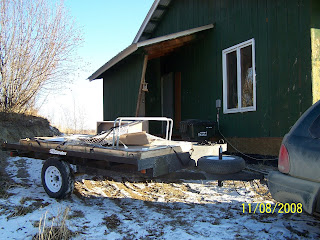
Normally it just means a quick stop at the shed to load up our Durango, but sometimes when there are big items like the whiteboard, soccer goals and filing cabinet that needed hauling this weekend, we hook up our trailer and do the hauling ourselves. From where we live we drive 7 miles to McNeil, load up, tie down, cover the stuff with tarps if the weather's wet, and then head 12 miles back up the road to Raz. At times we have to slow to a crawl because Basargin Road is still a bumpy mess from frost heaves last spring.

As I write this, Douglas is drilling holes in the walls, hanging whiteboards that were ordered in August and have finally come in. After years of trying to figure out a way to get high speed internet access out here, as well as Douglas' annoying persistence, the district tech folks finally made it happen. The school got high speed internet access in May a few days before school got out so I can actually blog from school.

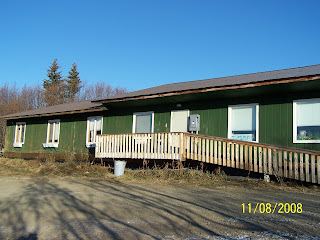
As you can see, the school is in need of a paint job. It is owned by members of the community of Razdolna and the school district leases it from them. An outside paint job was in the plans, but the inside of the school was completely rearranged and painted (by staff and student volunteers), and then new playground took priority.
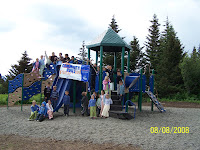
Over the summer a new playground was installed, almost completely at the expense of the villagers (the borough donated the play structure itself). It has become a new hub of the community as kids flock to the schoolyard to play.

The great challenge now is that the village needs a new school. The building you see above has a capacity of 50 people, and with 48 students enrolled this year, they are pushing the ticket. The village is growing and enrollment is expected to hit 76 in 3 years as families with young children begin to send them to school. However, the district will not build a new school; the villagers have to come up with the money themselves. A modest 3000 sq. ft. building would cost $600,000. With 26 families in the village who have to foot the bill, that seems like an insurmountable task (can you imagine someone asking you to foot the bill to build a new school building--on top of your own mortgage??!!). The villagers have been running fundraisers, selling Russian food and bake sales, but that is a drop in the bucket compared to what is needed. The architect fees alone to come up with a plan for the school (which is needed before they can get a loan) were $42,000!

Perspective. So while it is annoying to have to haul our own supplies to school and install them, it is such a small challenge compared to what the Russian's face in building a new school. It gives us a good feeling to know that these students are getting a good education, learning to read and write and do the things they will need to in order to make a good living for themselves.

Sunday, November 2, 2008

Got Studs?


We had a couple of weeks of snowy and icy roads at the beginning of October, leading to a flurry of activity as people got their studs put on. "Got your studs on?" was a common question as I ran into people I knew. And as I drive around town I see tires in backseats of cars and in the back of pickup trucks.

Studs? I thought that was a bit much before I lived in Alaska, but as you can see from the picture, they're just small metal nibs that stick out from the tires to give a little bit better grip on the road. I can see why they wouldn't want studs on roads in, say, the Midwest. With millions of cars traveling the roads, highways would be ripped up that much more quickly. But up here, with only 675,000 people in the whole state, and far fewer cars on any particular road, studs help keep people on the road, especially when a tow truck could take a long, long time to get there in rural areas.

Many people just purchase an entire extra set of tires for their vehicle with the studs already on them. They come either with the rims or without rims. With the rims means that anyone can quickly switch over to the new set of tires--pop off the tires like you're changing a tire and put the new one on. Without rims means you end up taking your car into a tire shop and they charge $15/tire to switch them over which is what we do. Some people may actually screw in the studs themselves and take them off again, using the same tire year round, but I don't know anyone who does this. So when we ask, "Got your studs on?" it doesn't mean we actually put the studs on, it just refers to whether the tires have been switched over.

The car is just a tad bit noiser driving with studs....kind of a clickety-clack sound. But it is well worth the security of better purchase on the roads--especially our very curvy, hilly East End Road out of Homer!

Saturday, November 1, 2008

Bear Alert!

Early this week we got a call from a neighbor across the canyon. "A grizzly bear is hanging around our house. Make sure you kids get a ride up to the bus." Douglas always drives them up, so that was no problem, but it shook us out of our complacency.

We've known there have been bear hanging out all summer, as some of our neighbors have prowled about with their guns looking for it. However, we'd assumed it was a black bear since we ran into one nearby in early summer. Black bears don't bother us as much as "brownies" or "grizzlies". Just the afternoon before this call our kids were picking crowberries in the canyon. We know canyons are favorite places for bears--both to hang out and to hibernate. But we hadn't heard about one in the area for a few months, so I gave the kids the ok to go exploring. They'd come dashing back into the house for bags to pick crowberries in a big patch they found on the canyon wall, and headed right back out. Luckily Denver has a loud voice, so we all feel somewhat safer when he is with us warning the wildlife of our presence.

But the bear alert in the morning, along with some of our trash scattered about put us on high alert. We purchased a bear-proof trash can, we've taken to carrying our .44 when we go for walks and the kids haven't had the desire to go exploring lately despite beautiful sunshiny weather. We're counting down till the bears go into hibernation, which is any time now. Since the snow we had earlier in Octber is gone, it has just been cold. When bears go into hibernation varies depending on a number of factors, including food supply, elevation, temperature, whether it has cubs, and amount of snow covering their food supply.

We'd gotten complacent about wildlife alertness, so this has raised it in our consciousness. It doesn't feel that "wild" up here in Alaska now that we're used to it. This is a good reminder to stay alert and aware.

Saturday, October 18, 2008

Good Eats in AK!

Everyone has something different that they like to do in places they live and visit. For us, the parks and hiking trails are one, and trying new restaurants is another. I thought I would share our favorite restaurants we have discovered in Alaska to date. If anyone has a good one to share, please let us know so we can try it out as we travel!

Cosmic Kitchen in Homer: You know a restaurant is good if it actually has 2 of them in a town the size of Homer! One is in the main part of town, while the other is out on the Spit. The smoothies are the best: they fill up a big cup with real fruit (not the imitation flavoring) and blend it up. Yum! The nachos are great, the burgers are delicious, and the only thing we have found that we don't like are some of their soups (they turn some things into soup that I wouldn't expect to be soup!). Overall, they are a good standby that we can always count on getting a good meal at.

Blackwater Bend between Homer and Anchor Point: I know, they're a coffee shop, not a restaurant, but I can't resist mentioning them. They're in the middle of nowhere (actually, across the road from Norman Lowell's studio & art gallery), but they nearly always have a line of cars at their drive-up window, which signals to me that they must be good! I tried a coffee smoothie there and it was divine! They have gigantic cinnamon rolls, and a nice selection of other on-the-go foods.

Hash Browns in Anchor Point: No restaurant is perfect, but I sure appreciate when they own up to their mistakes. When we went here a few weeks ago the waitress accidentally wrote down the wrong order for the kids. When I pointed it out to her, she didn't question it, she just took it right off the bill. It seems like most of the time if a restaurant makes a mistake you have to fight them to do anything about it, and it is more stress than it is worth. Hash Browns earned my loyalty by not making me fight. The pace of service is small town slow, so it is best to have plenty of time when you go.

The Crossings in Soldotna: This restaurant has the look of class, so I was not sure we would be welcomed when we wandered in one Saturday after a morning of berry picking, stains on our knees and twigs in our hair. When I asked the hostess about our attire, she just said meaningfully, "This is Alaska," so I guess dress is not an issue. This is a classy restaurant. It overlooks the Kenai River, has multiple levels, lots of windows, conservative and trained waitstaff, pleasant music, and good food. It was a gem to discover. We've spent $60 on plenty of meals in Alaska, but usually it was at a hole-in-the-wall with terrible service and bad food. We left The Crossings fully satisfied with our dining experience and happy to pay the restaurant for it. I am looking forward to an excuse to go there again when we're in town!

Alcapalco in Kenai: Again and again, the Alcapalco Mexican Restaurant is mentioned as a good place to eat at in Kenai when we ask people for a good restaurant. It has an extensive menu, and the two times I have been there the service was excellent--really outstanding. The food is good and the prices in line with what you are getting. It's nothing razzy dazzy, just a great place to go out for lunch with a group. Oh, and we really like their salsa. It will now be a regular stop for us when we are in Kenai to take some salsa to go.

There is an awesome Oriental buffet in Anchorage, and a great steakhouse/pub in Skagway, but I can't recall the names...I'll have to track them down.

The most fascinating thing about eating out in Alaska is the lack of chain restaurants. It is refreshing! Back in Gaylord, Michigan, I think the town was down to maybe 5 non-chain restaurants. It was hard to find a place to eat that actually had unique food. In Alaska the pendulum is far off in the other direction (at least in the non-metropolitan areas), with chain restaurants few and far between. I believe McDonald's is the only chain restaurant in Homer, out of something like 30 restaurants (in the summer). So we lose the consistency, but we gain when we find gems of culinary delight in out-of-the-way places. It takes much patience and trial and error to find good places to eat out. These are our favorites to date. Hope you enjoy them if you're in the area!

Wednesday, October 8, 2008

First snow...and still snowing

Sunday morning we woke up to a white world. Six inches of snow had collected overnight, transforming our green and brown world to black and white. The local pond (above) had a thin sheen of ice on it, and the ground was almost completely frozen. Just one week ago I cleaned out my garden: dug my veggies and pulled everything up. This was the day I was going to rent a rototiller and till in my compost. Looks like I missed the moment, and it's not going to happen till spring.

So Sunday was a play day, with the kids and I cross country skiing all over the local pastures, exploring the world from a different perspective! Snow forts went up, snowball fights ensued, hot cocoa was consumed and it was a joyous day. I fully expected the snow to all melt, as it was a sunny day, but it only melted a tiny bit, and snow has continued to drift down each day since adding to the base. It occurred to me that snow usually "sticks" till May 15 up here, so if this snow "sticks," that will be over 7 months of snow! Any takers??!! Or you can live in Homer where there's no snow (yet)!!

Sunday, October 5, 2008

Butchering the Local Cows

Friday our neighbors called and said they were butchering their cows, and did we want to come and watch or help? I was actually pretty excited to see the process, so Saturday was set aside to discover what it is like to butcher a cow...to see firsthand how food goes from a living animal to a steak on our plate.

Note: These are not the typical beautiful Alaskan pictures I post on my blog. However, if this blog is about "Life in Alaska", I don't feel quite right editing out the "rougher" or "baser" parts of life up here. People everywhere butcher cows (and goats, pigs, chickens, etc.), but for our family, it is not something we encountered or experienced in our lives up until now, so that makes it part of our "Alaskan" experience. My 10-year-old daughter used 2 words to describe this process: "interesting" and "boring". I agree. I hope you enjoy, or at the very least appreciate, this photojournal of the process.

Our neighbors are hunters, so it was a simple thing to choose the gun and bring it down to the cow pasture. Compared to being mauled and eaten by a wild animal, being shot is an easy way to go. The cows didn't know they were about to be killed, and even after a couple had been killed, skinned and gutted, the others just stood around watching. The was no sense of agitation at all. This is part of what surprised me about this process. Even chickens (which I have butchered myself) get more upset than these cows did.

Bleeding an animal needs to happen fairly quickly, so the moment the cow is down (one shot between the eyes), someone cuts the artery below the heart. It takes a few minutes for the reflexes to stop so that the cow stops kicking. I've seen this same reflex at work on moose that have been hit by a car. Once the cow has been bled, it is hung. In this case, our neighbors have a Cat with a forklift, which is very convenient. If this were a moose out in the woods the process would be a lot messier. The cow is brought to a good spot and laid on its back, propped up between a couple of logs to keep it steady.

Skinning the cow was the part I was dreading the most, I think, but I was amazed at how clean it was. The only blood is what might have gotten on the cow when it was bled. Other than that, it seems the blood is contained and so it is not a gory process at all. Really, sterile is the word that comes to mind. The skinning is routine work, and fairly simple. There were 4 of us "newbies" there to observe and help how we could, and we all felt pretty competent by time we were done. After the legs are skinned they are sawed off mid-leg, and after the belly has been sliced open, the sternum is sawed as well.

This entire process, from shot to the end when the cow is quartered and hung took less than an hour. Normally it takes them less time when they don't have inexperienced people helping. They take their cows to a processor so that they get good cuts, sausage, stew meat, etc. made up. Apparently the meat can hang for 10 days in cool weather before it begins to go bad. The heart is the only internal organ that they keep, and they give the tongues to someone who enjoys cooking them up.
For people who have been raised in hunting families or on farms, this is probably all old hat. I was not, so this was a new experience for me. I don't think I would go and start raising myself a cow and butchering it myself, but the whole concept of growing your own food--meat--is not quite so foreign to me anymore.

The carbon footprint for these cows is very low. They are raised on the farm over winter, fed grass, butchered here and driven a few miles down the road to the processor. Part of the problem with typical meat bought in the stores today is that it takes an immense amount of energy to grow, butcher, process and ship to stores all over the country or world. The carbon footprint is large, and much of the nutritional value of the meat is lost due to being corn-fed animals. It is neat to see how it "should" be done, or at least seeing that some people still have the skill, equipment and know-how to actually feed themselves.